



At 10:14pm Eastern on Friday 17 July, 3:14am on Saturday in London, Anthropic posted its sixth answer in six weeks to the question of who may use Claude Fable 5, and on what terms.[1] From Monday 20 July, the most capable model in the company’s range is included in the Max and Team Premium subscription tiers at half their usage limits. Pro and Team Standard subscribers, the ordinary paying customers, move to metered usage credits at API rates, softened by a one-off $100 credit. The company’s explanation was disarming in its plainness:
“Demand for Fable has been challenging to predict.”*[1]
Two days earlier, on Wednesday 16 July, Moonshot AI had released Kimi K3: a 2.8-trillion-parameter reasoning model with native vision, a one-million-token context window, and a price of $3 per million input tokens and $15 per million output.[2] The Beijing lab, founded by the former Google researcher Yang Zhilin and valued at roughly $20 billion this spring, says the full weights will be published for anyone to download by 27 July.[2][3]
One week, two frontier announcements. The American lab spent it deciding which of its customers may use its best model, and how much of it. The Chinese lab spent it publishing a download date.
There is also a number in Friday’s announcement that matters more than the $100, and it does not appear in the announcement. I will come to it.
In plain terms, for anyone whose organisation now pays for AI the way most do (a per-seat subscription here, an API bill there): the terms of access to frontier capability are being rewritten mid-contract, at days’ notice, in both directions at once. The line item your finance director approved in May does not describe what your teams can reach in July.
Six answers in six weeks
The Fable saga deserves to be laid out in order, because the order is the argument.
Fable 5 launched on 9 June as what Anthropic calls a Mythos-class model, priced at $10 per million input tokens and $50 per million output (the highest rates in the company’s general-availability range) and included, as a launch promotion, on Pro, Max, Team, and seat-based Enterprise plans through 22 June, after which it would require usage credits.[4] That was answer one. Answer two arrived three days later and was not Anthropic’s to give: on 12 June the US government applied export controls to Fable 5 and Mythos 5, and both models went dark for every non-American on Earth — the Friday-evening letter this publication examined at the time in Trump just proved your AI has an off switch

(https://thecontrollayer.arkava.ai/p/ai-sovereignty-anthropic-fable-mythos-export-ban-2026).[5]
The controls were lifted before the month ended, and answer three came on 30 June: Fable would return to Pro, Max, Team, and select Enterprise plans from 1 July, at up to half of weekly usage limits, through 7 July, with credits thereafter.[5] Answers four and five were extensions, granted as the company, in its own words, “secured additional capacity”: first to 12 July, after subscribers made their feelings known, then to 19 July.[6] Answer six is Friday’s settlement: permanent inclusion for Max and Team Premium at half limits, credits for everyone else, and the stated aim of giving users “more certainty about what your plan includes.”[1]
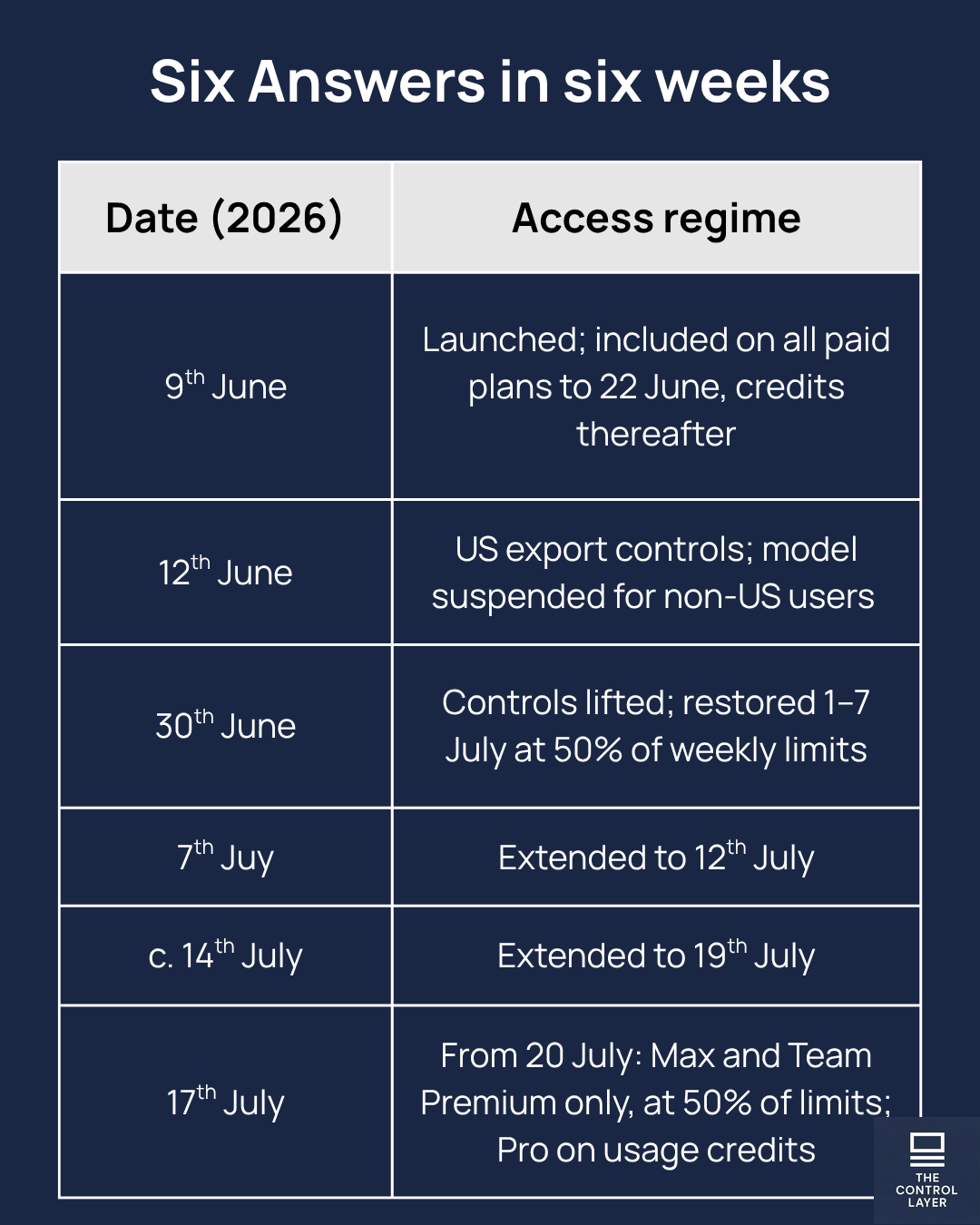
Fable 5 has spent its first six weeks as the industry’s Roy Batty — the light that burns twice as bright, told at intervals exactly how long it may burn — benchmarked at the top of the market on 9 June, export-controlled off it on the 12th, redeployed, extended, extended again, and now rationed by tier. No model this capable has ever had a first quarter this administratively eventful, and the pattern is worth more to a risk committee than any benchmark table.
The download date
Kimi K3’s numbers come first, because the numbers carry the story. The model holds 2.8 trillion parameters in a sparse mixture-of-experts design — in effect a committee of 896 specialist sub-networks, of which only 16 wake for any given token — built on architectural changes Moonshot calls Kimi Delta Attention and Attention Residuals, with native vision and a context window of a million tokens.[2] Moonshot claims roughly 2.5 times the scaling efficiency of its predecessor, which is the company’s account of how a model this size can be served at all, and the release dwarfs the next-largest open Chinese systems — DeepSeek‘s V4 Pro holds 1.6 trillion.[^3] OpenRouter, the model marketplace, describes K3 as “suited for complex coding, knowledge work, and long-horizon agentic workflows.”[^7]
The benchmark table Moonshot published is, by vendor standards, unusually honest. On the company’s own numbers, K3 mostly beats Claude Opus 4.8 and GPT-5.5 across a set of agentic and coding evaluations, and loses overall to Claude Fable 5 and OpenAI‘s GPT-5.6 Sol.[^2] A vendor conceding first place in its own launch table is rare enough to be information. Independent measurement, two days in, sits with the claim rather than the hype: Artificial Analysis scores K3 at 57 on its Intelligence Index — fourth of the 187 models it tracks, against an average of 31.[8] For a model with a download date attached, that is territory only DeepSeek has visited before.
Then there is the price, and the detail inside it. Simon Willison, the British developer whose independent model write-ups have become the trade’s first stop, spotted it within hours: $3 in and $15 out is exactly Claude Sonnet’s rate card, a fivefold jump from Kimi K2.6’s $0.95 and $4, and on his reckoning the most expensive model a Chinese lab has ever shipped.[9] The bargain phase of the Chinese open wave — the phase in which this publication could describe [the frontier premium dying]

— is over at the top end. Moonshot is not pricing against DeepSeek. It is pricing against Anthropic’s mid-tier, on capability grounds, and daring the market to disagree.
Two caveats belong on the record before anyone updates a procurement paper. The first is that a reasoning model’s rate card understates its bill, because reasoning models charge for thinking as well as answering. Artificial Analysis measured K3 as one of the most verbose models it has evaluated (130 million output tokens across its test suite, against a 63-million average), and Willison’s single test prompt, an SVG drawing of a pelican on a bicycle, consumed 13,241 reasoning tokens to produce 3,417 tokens of answer, at a cost of about 25 cents.[8][9] Budget on effective cost per task, never on the per-token price. The second caveat is that until the weights ship, the open-weight claim is a promise: Artificial Analysis currently classifies K3 as proprietary, for the simple reason that the weights are not yet public.[8] Open in intent, API-first in fact. The 27th is the test.
The honest case for the meter
I want to be fair to Anthropic here, because the easy column, “chaotic lab cannot make up its mind”, writes itself, and it is not quite right.
Serving a Mythos-class model to millions of subscribers at a flat monthly price is a different business from selling it by the token, and the constraint on it is physical. Every GPU-hour spent answering a Max subscriber is a GPU-hour not spent training the next model (the inference-versus-training allocation this publication examined in The Inference Flip,

and Willison’s read of Friday’s move is precisely that trade: a company discovering that subscribers will not accept premium pricing without the flagship model, and that including the flagship means diverting compute from research to serving.[9] Seen that way, six answers in six weeks was a lab discovering demand in real time, in public, with the added interruption of a fortnight in which Washington took the decision out of its hands entirely. A one-off credit and a permanent answer amount to more consideration than software subscribers usually get when the economics move.
Moonshot deserves the same fairness in the other direction. A 2.8-trillion-parameter reasoning model is expensive to serve, and pricing it at Sonnet rates is a statement that Chinese frontier labs no longer feel obliged to buy the world’s attention with loss-leading tokens. Nobody in this story is gouging. Both price cards are telling you the same true thing about what frontier intelligence costs to run in mid-2026.
But.
The meter is the product
The argument I want to make is that the two announcements are one story, and the story is about what is actually for sale.
On the closed side of the frontier, what you buy is no longer a model. It is a metered entitlement — sized by tier, adjustable by the provider, revocable under conditions you do not control — to a capability whose withdrawal, as June demonstrated, you cannot always foresee. Six access regimes in six weeks is not a pricing strategy; it is a capacity confession. And note that Anthropic behaved reasonably at every step, because that is rather the point. A well-run, well-capitalised, safety-forward lab, operating under ordinary commercial physics, still produced an access record no procurement officer would accept from a payroll vendor. When the honest operation of a system produces that volatility, the volatility is the system.
Frank Herbert put the underlying law in one sentence seventy years ago:
“he who controls the spice controls the universe.”
The insight in Dune concerns the schedule more than the substance — whoever meters the flow of the thing everyone depends on governs everyone who depends on it. The spice was never the product. The control was.
And here is the number I promised at the top.
On the same Monday the new arrangement takes effect, by the German AI outlet The Decoder‘s reading of the changes, the bonus-usage phase that ran through the promotional period ends as well — and regular usage limits come down by roughly a third.[10] The headline is that Fable became permanent. The mechanism is that the meter tightened for everyone, including the tiers that won. In The Expanse, the inners never think about air because the valve is set somewhere else, by someone else; the Belters think about little else. From Monday, a Max subscriber and a Pro subscriber of the same product live on opposite sides of that valve.
On the open side, the story inverts. What Moonshot sells at $3 and $15 is convenience — the hosted, metered version of a thing that will, if the 27th holds, exist independently of Moonshot’s meter altogether. The weights change the ownership question in a way no price can: an enterprise that downloads K3 and runs it on its own hardware — under its own law, on its own electricity, at its own depreciation schedule — has converted intelligence from an entitlement back into an asset. That was never going to be cheap, and Moonshot’s rate card no longer pretends it is. What open weights buy is the valve.
A month ago, after Washington’s fortnight with the off switch, I wrote that a model you can be denied is a permission, not a possession. Friday priced the permission. The 27th, if Moonshot ships, prices the possession.
The publication that calls its predictions in writing.
Every Control Layer piece ends with a falsifiable prediction and a list of signals to watch. Subscribe to track them. One email a week. Free.
The bottom line
The comfortable reading of the week is two unrelated product stories: a Chinese lab shipped a big model, and an American lab tidied its subscription tiers. The comfortable reading is wrong, and the uncomfortable one is where the truth resides. The frontier has split into two economies: a closed one in which capability is rented through a meter the provider sets and resets, and an open one in which capability can, at real and rising cost, be owned outright. Every organisation that depends on this technology now sits in one of the two, whether or not it has chosen.
Fable 5 remains, by its newest rival’s own published table, the best model in the world. From Monday it is also the clearest demonstration that “best” and “available” have become separate questions — priced separately, governed separately, and changing on separate schedules. Moonshot, meanwhile, has stopped pretending open weights mean cheap intelligence and started demonstrating that they mean governable intelligence. Two labs, one week, the same lesson from opposite directions.
The meter, not the model, is the product.
References
[1]: Claude (@claudeai), X post, 10:14pm ET, 17 July 2026: “Beginning July 20, Claude Fable 5 will be included in all Max and Team Premium plans, at 50% of limits. Pro and Team Standard users will continue to have access to Fable via usage credits, and will receive a one-time $100 credit…”

; corroborated in Dawn, “Anthropic to add Claude’s Fable 5 model to Max, Team Premium plans at 50pc of usage limits.” 18 July 2026.
[2]: Moonshot AI. “Kimi K3 Tech Blog: Open Frontier Intelligence.” 16 July 2026.
[3]: MLQ News. “Moonshot AI Releases Kimi K3, a 2.8-Trillion-Parameter Open-Weight Model Rivaling Top U.S. Systems.” 16 July 2026.
[4]: Anthropic. “Claude Fable 5 and Claude Mythos 5.” 9 June 2026.
[5]: Anthropic. “Redeploying Claude Fable 5.” 30 June 2026.
[6]: Tech Times. “Claude Fable 5 Ends Subscription Limbo: Permanent for Max, Credits-Only for Pro.” 18 July 2026.
[7]: OpenRouter. “MoonshotAI: Kimi K3 — API Pricing & Benchmarks.” Accessed 18 July 2026.
[8]: Artificial Analysis. “Kimi K3 — Intelligence, Performance & Price Analysis.” Accessed 18 July 2026.
[9]: Simon Willison. “Kimi K3, and what we can still learn from the pelican benchmark.”*16 July 2026. ; and “Claude make Fable 5 permanent.” 18 July 2026.
[10]: The Decoder. “Anthropic slashes Claude Fable 5 limits in Max and Team Premium and pushes Pro users toward API pricing.” 18 July 2026.
Author
Amer Altaf is Founder and CEO of Arkava, a UK and European sovereign AI agentic-automation business, and Managing Editor of The Control Layer

The publication where he tracks the convergence of cybersecurity, technology sovereignty, and geopolitics. A techUK member, he contributes to industry engagement on UK technology-sovereignty policy. He is currently writing on cloud security for Oxford University Press’s Expert Essentials series.