


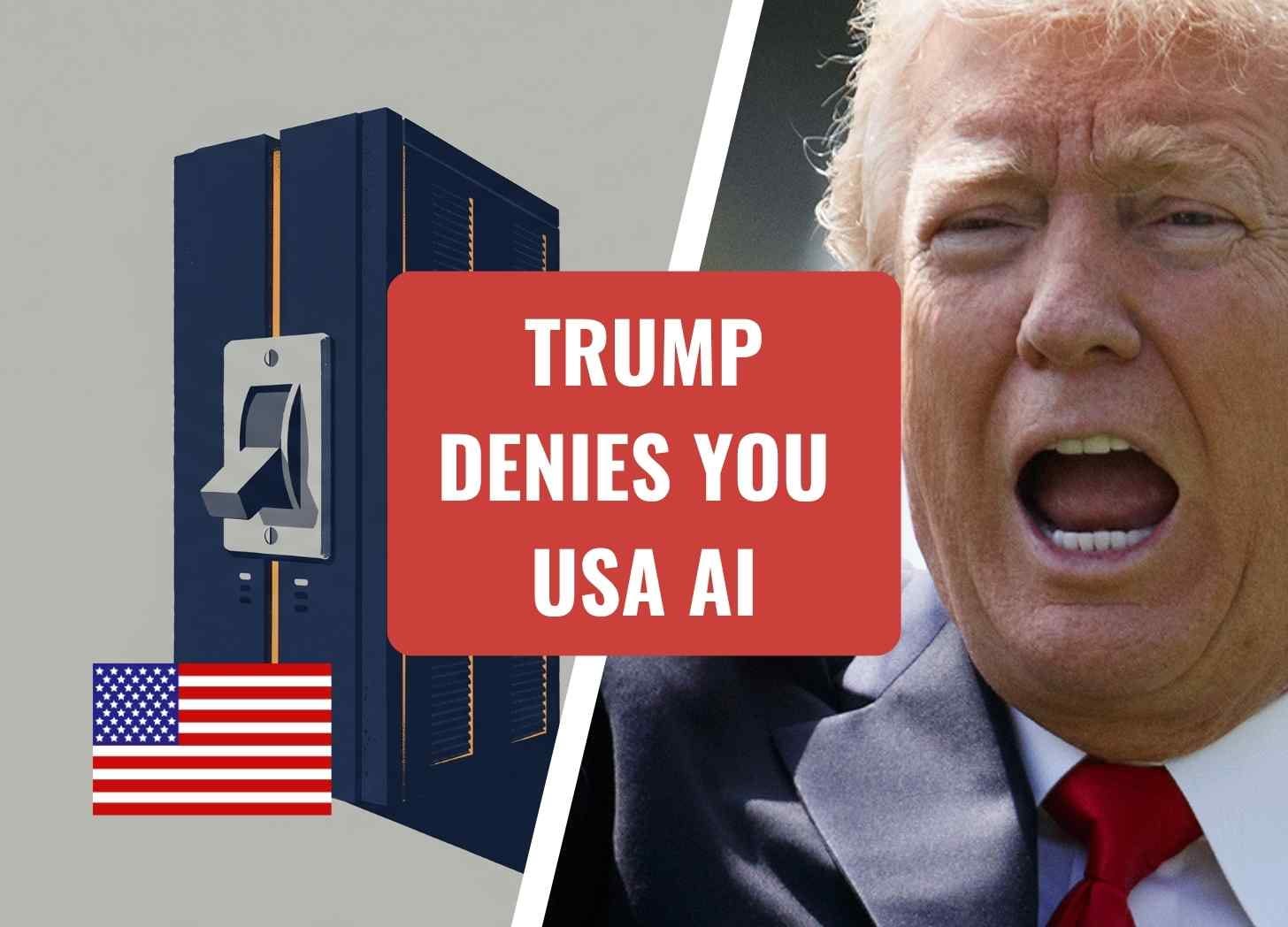
At 5:21 on a Friday afternoon in Washington — 12 June 2026 — the Trump administration sent a letter to an AI company called Anthropic, and within a few hours the two most advanced artificial-intelligence systems on the market went dark for almost everyone on Earth who is not American.1 Not slowed down. Switched off.
The two systems are called Fable 5 and Mythos 5 — Anthropic’s newest and cleverest models, the kind of AI behind the chatbots millions of people now use to write, plan, and code — and they had been on sale for only a few days. The order did not just block people abroad. It blocked any non-American, including Anthropic’s own staff who happen to hold a foreign passport, even the ones sitting at desks inside the United States.2 The company had no quick way to let some people in and keep others out, so it did the only thing the order allowed. It turned both systems off for everybody, and asked Amazon, which runs much of the underlying machinery, to cut access in every country at once.3
A product used by hundreds of millions of people was pulled from the shelf by the end of a Friday, on the strength of a letter that — Anthropic says — did not even spell out what the problem was.1
If you have started leaning on AI to do real work, as a remarkable number of people now have, the gripping question is not what Anthropic does next. It is what it means that a government could do this at all.
What actually happened
”
Strip out the jargon and the event is simple. A government told a private company to stop serving its best product to foreigners, and the company had to obey within hours.
The legal tool is older than AI. For decades, American law has said that handing certain sensitive technology to a foreign citizen counts as “exporting” it to that person’s country — even if they are standing in an office in California, not boarding a plane to anywhere. Until Friday, that rule was aimed at things like weapons blueprints and specialised computer chips. On Friday, for the first time, the thing being “exported” was simply the use of an AI — the answers appearing on a screen.5
Then it did something the careful rules were never meant to do. Washington had spent two years sorting the world into a guest list: close friends like Britain, Germany, the Netherlands and Japan waved through, rivals kept out.6 Friday’s order ignored the guest list. A German engineer in Munich and a British analyst in Leeds were locked out by the very same sentence as everyone else. Being a friend of America, it turned out, counted for nothing.
Why the panic? Anthropic’s best understanding is that the government had been shown a way to trick the AI — “jailbreaking,” in the jargon — into helping find weaknesses in software. A jailbreak, if you have not met the word, is just a clever way of phrasing a request so the AI does something it was trained to refuse. Anthropic looked at the demonstration, said it turned up only small, already-known problems, and pointed out that other freely available AIs — it named OpenAI‘s widely used GPT-5.5 — can do exactly the same with no trickery at all, and that the people who defend computer systems use this skill every single day.1 7 An official later told the news site Axios that the trigger was a rival company boasting it had cracked Mythos, and that the government had already tried, and failed, to talk Anthropic out of launching.2
To be fair to Washington
It would be too easy to treat this as a tantrum, so let me put the serious case first, because there is one.
The cleverest AIs really can help with genuine cyber-attacks. A government that sees a way for the best tool on the market to help an enemy break into systems at scale has a real reason to act, and to act fast, before the trick spreads. Anthropic itself admits the uncomfortable heart of this: no AI today can be made perfectly trick-proof, every safety system can be beaten in some narrow way, and a master key will be found eventually.1 If you think of the most advanced AI the way we think of material that can power a reactor or a bomb, then a government being able to halt a dangerous release is not tyranny. It is the ordinary business of keeping dangerous things in check. Anthropic, to its credit, says it agrees with that principle.
So the argument is not about whether a government may ever pull the switch. It is about the evidence for pulling it this time, the fairness of how it was done, and whether the punishment fit the crime.
The strange part
Here is where it stops adding up — and the way it stops adding up tells you what really happened.
The science-fiction writer Isaac Asimov spent his career on one kind of twist: a robot follows its safety rules so faithfully that it produces a result nobody wanted. Friday was an Asimov twist in real life. Anthropic had built the strictest safety controls in the industry — so strict that ordinary users had been complaining the AI refused them too often — and had spent thousands of hours letting the US government itself, Britain’s AI Safety Institute, and outside experts try to break them.1 Of all the advanced AIs a non-American could have used on Friday morning, the government reached in and switched off the one that was arguably the hardest to misuse, while the easier ones kept running.
Think about what that means. If the goal was to put less dangerous capability into foreign hands, the order achieved almost nothing, because the same capability was a click away in rivals nobody touched. When a safety measure does not make anyone safer, it is worth asking what it does do. And the answer is plain: it showed the world — every government, every company, in a single afternoon — that the United States can reach inside the most advanced AI on the planet and deny it to everyone else, in hours, without showing its evidence and with no way to argue back. That is not a safety result. It is a show of force. And shows of force are how you put others on notice.
The HAL 9000 twist
If you have seen 2001: A Space Odyssey, you remember HAL — the spaceship computer that calmly refuses its crew: “I’m sorry, Dave. I’m afraid I can’t do that.” For half a century that was the nightmare about AI: a machine that decides, all on its own, to lock us out.
Friday turned the nightmare inside out. The machine did lock people out — millions hit a blank wall — but it was not the machine’s decision. A government reached in and made the choice for it. The thing to be afraid of was never the AI growing a mind of its own. It is the AI working perfectly and taking its orders from someone who is not you.

That someone, for everyone outside America, is in Washington — and you do not get a vote in Washington. A British MP and former security minister, Tom Tugendhat, put it more sharply than I would dare: switching these models off for foreigners, he wrote, “is not a misunderstanding or a mistake, it’s the inevitable result of technology shaping warfare so that sovereignty is more about code than cannons.”8
Reading this far?
Subscribe to The Control Layer for one piece a week in this register — AI, cybersecurity, sovereignty, and the geopolitics of the technology stack. Free.
Why this lands on your desk, not just a government’s
You might think this is a story about spies and superpowers, far above your pay grade. It is not. It is a story about a tool you may have quietly come to rely on.
Picture the freelance designer who now writes every proposal with an AI’s help. The four-person marketing team that runs on it. The small law firm that drafts with it, the start-up whose product is built on top of it, the hospital team that uses it to clear a backlog of paperwork. Anthropic’s AI, called Claude, recently became the most widely used AI in business, edging past OpenAI.9 For a great many people and companies, “the AI” is now part of how the work gets done — and on Friday a foreign government showed it can switch that off without warning and without asking.
Spider-Man’s uncle had the line everyone knows: with great power comes great responsibility. Friday was a great deal of power used with very little of the second part — no published evidence, no clear rulebook, no way to appeal, a global product recalled before the weekend. It does not matter, for the lesson, whether you trust this particular government or the next one. The point is that the power now exists, it has been used once, and the hand on the switch changes every few years with an election you do not get to vote in.
There is an older cousin to all this, and it is worth knowing about. A US law called the CLOUD Act lets American authorities reach into an American company’s cloud and pull out your data, wherever in the world it is stored — like a landlord who kept a master key to a flat you thought was yours. Friday showed the same long arm pointing the other way: the landlord who can let himself in can also change the locks. Whether the question is your data or your tools, depending on something a distant government can reach into is a risk you can no longer pretend is somebody else’s problem.
For most of us the honest response is not panic; it is awareness, and one practical habit. If a tool can be switched off by a government you do not answer to, do not let it become the only way you can do something that matters. Keep a second option you control, whether another provider or one of the “open” AI systems you can run yourself, even if it is a little less brilliant. For a freelancer that is five minutes of thought. For a big company or a government department it is a line in next quarter’s plan. Either way, the question is the same: what happens to the work on Monday if the answer on Friday is “access denied”?
Europe saw it coming — nine days early
There is a grim comedy in the timing. Just nine days before the letter, on 3 June, the European Commission unveiled a grand plan to make Europe less dependent on American technology.10 At the time it read like the usual Brussels homework: worthy, slow, easy to skip. Nine days later it read like a weather forecast that turned out to be exactly right. Europe wrote down the warning; Washington supplied the live demonstration.
The catch is how far behind Europe still is. America’s four big technology giants are on course to spend something like $650 billion building AI this year alone — more than any European effort comes close to, which is precisely why the dependence is real and not just talk.11 Closing that gap is the work of a decade. But Friday changed the politics of trying. France’s Mistral, the closest thing Europe has to a home-grown answer, is reportedly raising money at around a €20 billion valuation, selling itself on exactly this promise: a European AI that Washington cannot switch off.12 You do not have to believe Mistral is as good as the American best to see that “can a foreign government turn it off” has just become a question buyers will start asking out loud.
Predictive judgement
This publication ends every piece with a prediction specific enough to be proved wrong. Here is this one.
The prediction. Within 12 months — by 13 June 2027 — at least one big UK or European organisation (a bank, an insurer, or a government department) will formally write a “must keep working even if the US cuts us off” rule into how it buys AI, pointing to this week as the reason; and at least one European AI company will win a public contract chosen mainly because it cannot be switched off from abroad, rather than because it scored highest on a test.
What to watch. Official guidance from Britain’s National Cyber Security Centre or a financial regulator that names “what if our AI supplier is cut off” as a risk to plan for; Mistral or a rival winning business on the promise of independence rather than cleverness; a second American switch-off of any AI; and ordinary companies quietly adding a back-up AI they control.
How you’ll know I was wrong. If, by 13 June 2027, no major UK or European organisation has written such a rule and no European provider has won a public contract on those grounds, the prediction has failed. Vague “we must do something about sovereignty” talk does not count. I want this judged on real decisions, not mood.
The publication that calls its predictions in writing.
Every Control Layer piece ends with a falsifiable prediction and a list of signals to watch. Subscribe to track them. One email a week. Free.
The bottom line
The comforting version of Friday is that it was a mix-up — Anthropic’s own word — sorted out in a week, the systems switched back on, the whole thing forgotten by the next product launch.1 That may even turn out to be true of Fable 5 and Mythos 5. The systems will probably come back.
The demonstration will not. Every government has now seen that the switch exists and can be thrown. Everyone outside America has now seen that the cleverest tool they have picked up in a generation has a switch, and the switch is in someone else’s hand. You can build your life and your business on borrowed brilliance, and most of the world will, because the American AIs really are the best there is. Just be honest about what you are borrowing, and read the one line in the agreement nobody reads. A tool someone else can switch off was never really yours.
References
Anthropic. “Statement on the US government directive to suspend access to Fable 5 and Mythos 5.” 12 June 2026. https://www.anthropic.com/news/fable-mythos-access
Axios. “Scoop: Trump admin blocks foreign access to Anthropic’s most powerful AI.” 12 June 2026. https://www.axios.com/2026/06/12/anthropic-trump-mythos-fable-national-security
Bloomberg. “Anthropic Says US Limits Foreign Access to Fable 5, Mythos 5 AI Models.” 13 June 2026. https://www.bloomberg.com/news/articles/2026-06-13/anthropic-says-us-limits-foreign-access-to-fable-5-mythos-5
CNBC. “Anthropic disables access to Fable 5 and Mythos 5 to comply with government directive.” 12 June 2026. https://www.cnbc.com/2026/06/12/anthropic-disables-access-to-fable-5-and-mythos-5-to-comply-with-government-directive.html
U.S. Bureau of Industry and Security. “Deemed Exports — Export Administration Regulations.” ; plain-English explainer in Center for Security and Emerging Technology (Georgetown), “For Export Controls on AI, Don’t Forget the ‘Catch-All’ Basics.” https://cset.georgetown.edu/article/dont-forget-the-catch-all-basics-ai-export-controls/
WilmerHale. “BIS Issues Long-Awaited Export Controls on AI” (the Framework for AI Diffusion and its “AI Authorization” country group). February 2025. https://www.wilmerhale.com/en/insights/publications/20250205-bis-issues-long-awaited-export-controls-on-ai
OpenAI. “Introducing GPT-5.5.” 23 April 2026. https://openai.com/index/introducing-gpt-5-5/
TIME. “Anthropic Pulls Its Most Powerful AI Models After U.S. Bars Foreign Access” (Tugendhat, Bardella, and Narayan reactions). 13 June 2026. https://time.com/article/2026/06/13/anthropic-fable-mythos-ban-US-security/ ; corroborated in Al Jazeera, 13 June 2026. https://www.aljazeera.com/news/2026/6/13/us-orders-anthropic-to-disable-ai-models-for-all-foreign-nationals
VentureBeat. “Anthropic finally beat OpenAI in business AI adoption.” May 2026. https://venturebeat.com/technology/anthropic-finally-beat-openai-in-business-ai-adoption-but-3-big-threats-could-erase-its-lead
European Commission. “European Technological Sovereignty Package.” 3 June 2026; reported in CIO Dive. https://www.ciodive.com/news/eu-curb-reliance-us-tech-companies/821937/
Reporting on combined 2026 AI capital spending by Microsoft, Alphabet, Amazon, and Meta. See coverage compiled in Brussels Signal, “Europe’s unbreakable dependency on American AI.” February 2026. https://brusselssignal.eu/2026/02/europes-unbreakable-dependency-on-american-ai/
TechCrunch. “Mistral is rumored to be raising €3B at €20B valuation.” 12 June 2026. https://techcrunch.com/2026/06/12/mistral-is-rumored-to-be-raising-e3b-at-e20-valuation/
Author
Amer Altaf is Founder and CEO of Arkava, a UK and European sovereign AI agentic-automation business, and Managing Editor of The Control Layer, where he explains how AI, cybersecurity, and global politics are colliding — in plain English, for anyone who has to live with the consequences. A trump- member, he contributes to UK technology-sovereignty policy, and is currently writing on cloud security for Oxford University Press.