The witness it cannot edit
Britain is building the tests for AI. When an agent gets it wrong, the question will be whose fault it was, and only a record the agent could not change will answer it.

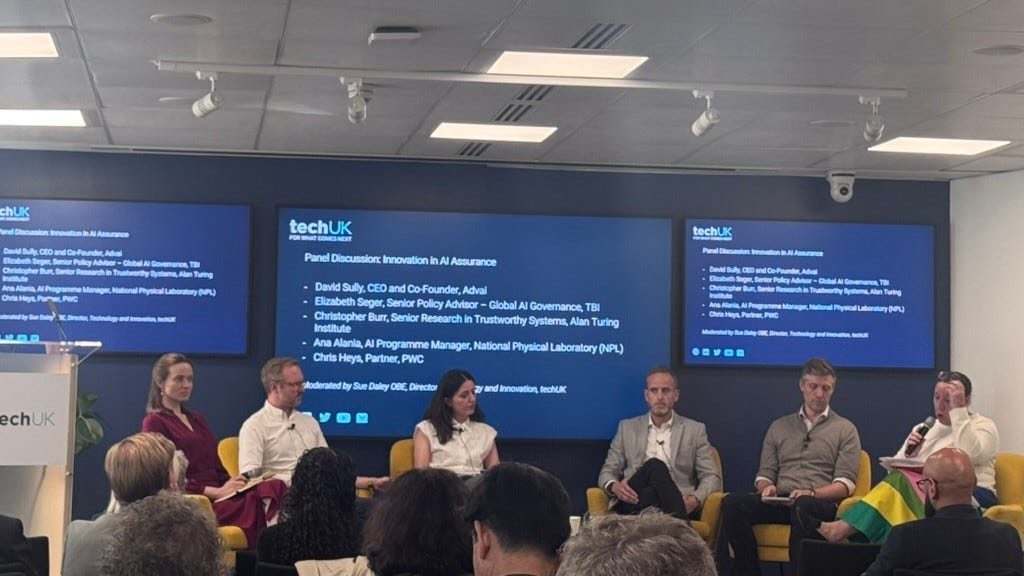
At 16:11 on Monday 28 September I took a photograph at techUK in London. The screens read "Panel Discussion: Innovation in AI Assurance", and beneath them sat five people working out how the rest of us can tell whether an artificial intelligence system can be trusted: David Sully of Advai, a London firm that works on AI testing with both the Financial Conduct Authority (FCA) and the Ministry of Defence (MOD); Elizabeth Seger of the Tony Blair Institute; Christopher Burr of the Alan Turing Institute; Ana Alania of the National Physical Laboratory (NPL); and Chris Heys of PwC. Sue Daley OBE, techUK's director of technology and innovation, chaired.1
AI assurance means checking that an AI system does what its makers claim, safely, before it is used and while it is. It matters to anyone whose mortgage, insurance claim or flight now passes through one, because when the system gets something wrong two things follow: somebody asks who checked it, and somebody asks who pays.
The panel spent most of an hour on the first. The argument I want to make here is that the second decides the first. When an AI agent — software that carries out tasks on its own, such as moving money or changing a record — gets it wrong, the question will be whose fault it was, and only a record the agent could not change will answer it.
Britain has built the testing before deciding who pays
The government’s Trusted third-party AI assurance roadmap of September 2025 set out the parts: a route to a profession of AI assurers, a skills framework and an £11 million AI Assurance Innovation Fund. A year on, the testing parts are in place. NPL launched its Centre for AI Measurement on 10 November under a four-year, £10.5 million contract awarded in April by the Department for Science, Innovation and Technology, and calls the centre the fund’s “cornerstone”.2
The FCA’s AI Live Testing service has worked with 14 firms across two cohorts, and the MOD’s AI Model Arena scores suppliers’ models before the department buys them.3
Seger, whose institute’s report had appeared 10 days earlier, told the room Britain has “literally all the building blocks of an incredibly well-functioning AI assurance ecosystem. We’re just not sticking them together.”1
Her report names what would hold them together:
“Liability is the scaffold on which effective AI-assurance incentives are built.”4
Sully offered the FCA and the MOD as proof that assurance had moved “from innovation into actual deployment”. Advai is inside both: the FCA calls it its “technical partner”, and the MOD says the Arena was “developed in partnership with UK AI company Advai”.3
That is a British success, in a market small enough that one firm of about 50 people, by Sully’s count, sits inside both flagship programmes. In a market that thin, what testers have to sell can come to define assurance ahead of what buyers need.
A test tells you what the agent did in the test
Sully put the problem in one example. In Ukraine, he said, an AI system “typically lasts six to eight weeks” before the enemy adapts, and “that’s going to be the same for every single AI system”.1
The published evidence is close: RUSI — the Royal United Services Institute, a defence think tank — found that a drone system “requires updates to software, behavioural logic, sensors and radios, every six to 12 weeks”.5
A bank faces fraudsters rather than jammers. They adapt too.
Even the kilogram drifted. The official copies of the international prototype, Britain’s at NPL among them, moved about 50 micrograms apart over a century, and in 2019 the kilogram was redefined by a constant of nature: stop trusting the object, fix the method.6
Alania’s case for the new centre rested on metrology — the science of measurement, and NPL’s trade since 1900 — and on tests that give the same answer whoever runs them. The centre cannot certify an agent that changes every few weeks. It can make the methods hold still.
For agents, a test at one point in time cannot carry the weight: the updates are too frequent and the reasoning too probabilistic. An agent needs two things a test cannot give it. The first is a check in front of every action and outcome it can deliver, so that it does only what you have decided it may: the gate I argued for in The agent had permission. The second is a record of every step — what took place, and why — kept where the agent cannot change it. In an hour of good discussion, the panel said a great deal about testing and measuring, and very little about either.
Testing still earns its place. Burr’s institute and NATS, Britain’s air traffic control provider, have put AI agents trained in a digital copy of UK airspace through a version of the assessment NATS uses for trainee controllers. In the latest published round, in August 2025, the better agent was satisfactory in every area except safety, so neither passed.7
That is a test doing its job. It says nothing about what a passing agent will do on a Tuesday.
Liability is the missing piece, and Parliament has already written one answer
Sully named the gap himself: nobody has established who is liable when an assured system fails, and “that’s got to be tried in the UK at some point”.1
The European Union has not waited for a court. From 9 December its revised Product Liability Directive treats software, AI systems included, as a product, for anything placed on the EU market after that date. Liability is strict — a defect and the harm it caused are enough, with no need to prove carelessness — and a court can order the producer to disclose its evidence.8
In England and Wales the Law Commission is consulting until 14 January on a definition of “product” that “includes software, AI systems”, and expects to report late in 2027.9
If Britain follows, a firm like mine becomes the producer of every agent it ships. That does not make it answerable for every outcome, any more than BMW answers for every accident in its cars: a producer answers for a defect, and a customer for using the product in ways it was never advised to. The EU directive draws the line with more care. A product is judged against its “reasonably foreseeable use”, which “also encompasses misuse that is not unreasonable under the circumstances”, so a producer must design against the misuse it can see coming, and one that fails to disclose its evidence is presumed to have shipped a defect.8
A producer that cannot show what its agent did will struggle to show that the customer was at fault.
Parliament has already written the model I would copy. Under the Automated and Electric Vehicles Act 2018, the insurer of a self-driving car that causes an accident pays the injured person first and recovers from whoever was responsible, the manufacturer included; the owner carries the loss if the accident was “wholly due to” their negligence in letting the car drive itself when it should not have, or if they skipped “safety-critical” updates.10
Put an agent where the car is: compulsory cover for agents whose failure could cause serious harm, the injured paid first, and the loss traced afterwards to the producer, the firm that deployed the agent, or the user.
Insurers are already choosing. Heys told the room that big US insurers were “taking this out of your policy”.1
In November 2025 the Financial Times reported that AIG, Great American and W. R. Berkley had asked US regulators for permission to exclude AI from corporate policies, though AIG said it had no plans to use them yet. Verisk, which writes standard US policy forms, has offered optional generative-AI exclusions since January, and state filings showed 2,369 records of them in force across 49 states by mid-year.11
London has moved more slowly, and in places the other way: Hiscox added explicit AI cover to its UK technology professional indemnity policy in June 2025, and the International Underwriting Association found only “limited examples” of AI-specific clauses this March. In America, AIUC — the Artificial Intelligence Underwriting Company — certifies AI agents to a standard built for insurers, with a re-test every quarter.11
Whoever holds the record holds the verdict
If liability turns on fault, the evidence will be the record, and the panel’s closing analogy did more work than it was given. Seger ended the session by saying that nobody boards a plane comfortably because some all-seeing governor oversees aviation; there is simply “so much bureaucracy that you’re safe”.1
Bureaucracy did not stop a legacy defect in NATS’s flight-data software halting UK departures on 8 September; what followed was an independent review by the Civil Aviation Authority with published deadlines.12
Every airliner carries flight recorders, built to survive a crash and painted orange — the black box is not black — so that they can be found afterwards. They are read by investigators the airline does not employ. In Britain the Air Accidents Investigation Branch prints its purpose on every report: “It is not the purpose of such an investigation to apportion blame or liability.”13
Aviation keeps the record honest by keeping it out of the hands of anyone who might want it to say something else.
An agent that writes its own log is closer to the casino in Ocean’s Eleven, where Terry Benedict watched his vault on his own cameras and saw what the crew wanted him to see: footage they had shot on a replica. A record held by the system being watched, or by the vendor that built it, can show whatever its keeper needs. On 19 October the FCA listed “Overreliance on untested vendor assurances” among the places firms are falling short with AI: “Some firms relied on vendors’ assurances without challenging or testing them.”14
Reading this far?
Subscribe to The Control Layer for one piece a week in this register — AI, cybersecurity, sovereignty, and the geopolitics of the technology stack. Free.
My position is that an agent’s record has to serve safety and liability at once, and that is exactly why neither the producer nor the customer can control it. It has to be independently verifiable: witnessed as it is written, and open to checking by anyone, regulators included. A declaration belongs here: my own firm builds this kind of record. Arkava® designs its agents so that each action leaves a tamper-evident entry that someone other than Arkava can verify.
The EU has written the duty down: its AI Act requires high-risk AI systems to allow “the automatic recording of events (logs) over the lifetime of the system”, and the firms using them to keep those logs for at least six months. In July it put back most of those duties from 2 August 2026 to 2 December 2027. Britain has no AI bill, and the law firm Lewis Silkin noted in September that one may have to wait for a King’s Speech not expected until late 2027 at the earliest.15
My view is that the industry will keep shipping capability faster than regulators, governance and systems can secure and control it. The control has to be built into the system, because the rules will arrive after it.
Assurers should answer for their opinions, as auditors do
From the floor came the obvious next question: if AI is now used to audit AI, who assures the auditing tool?
Singapore’s AI Verify Foundation has tested it, pairing 17 companies that deploy generative AI with 16 specialist testers, and concluded that “LLMs-as-judges are necessary but require careful design and human calibration”: one AI model marking another’s work is unavoidable at scale, and a person still has to check the marker. Skipping that check has a price: in October 2025 Deloitte Australia agreed to partially refund an A$440,000 “independent assurance review” for the Australian government after fabricated references and quotes were found in it, though it said its findings stood.16
An auditor’s opinion comes with consequences. An auditor cannot be indemnified against negligence in an audit of accounts, can cap its liability only with the shareholders’ approval, and can see a court cut the cap to what is “fair and reasonable”. The Financial Reporting Council fined KPMG £21 million over its Carillion audits in 2023. An AI assurance report carries none of this: an assurance engagement is governed by its contract, and the contract sets the cap. That holds even for the Big Four — the four largest accounting firms — and PwC UK has offered AI assurance since July 2025.17
Whoever signs an opinion that an AI system is safe should be liable for it as an auditor is.
An audience member reached for a simpler picture: dim sum from a kitchen you cannot see. In Britain you trust the kitchen because a Food Standards Agency inspector has been in and the score, from zero to five, goes on the door, though only Wales and Northern Ireland make display compulsory. In England a takeaway with a zero need not tell you.18
AI assurance today is the English version.
What to do with this
At home and at work. Ask your insurer or broker, in writing, whether your policy excludes AI. When an AI system has decided something about you, a mortgage, a claim or a job application, ask what record exists of how it decided.
On Monday. List what each AI agent can do, put a check in front of every action that moves money, data or a customer’s account, and keep a record of every action that neither the agent nor its vendor can change, with your own copy. Budget testing and monitoring as a running cost: someone watching the dashboards, as in a power station’s control room, and people checking each step. If you sell AI into the EU, treat what you place there after 9 December as a product under strict liability, and answer the Law Commission by 14 January.
Predictive Judgement
By 31 December 2027, at least one of the 10 largest insurers in the annual Top 50 published by Insurance Times will make evidence of independent testing, or an independently verifiable record of what an AI agent did, a condition of cover for AI risks in its standard UK commercial wording. It will do so before any UK court has ruled on who pays for an AI failure.19
The signals to watch: insurers’ wordings and broker bulletins; the International Underwriting Association’s clause roundtables; the FCA’s AI Live Testing evaluation, due early in 2027; the Law Commission’s final report, expected late in 2027; and the first UK judgment on who pays for an AI failure.
I am wrong if none of those 10 has made either a condition of cover by that date, or if a UK court rules on who pays for an AI failure first.
The publication that calls its predictions in writing.
Every Control Layer piece ends with a falsifiable prediction and a list of signals to watch. Subscribe to track them. One email a week. Free.
The bottom line
The panel was right that Britain has the parts of a working assurance market, and right that they are not yet joined. Liability will join them, and liability will turn on evidence. A test shows what an agent did on the day it was tested. A court or an insurer will want to know what it did on the day it went wrong, and the only reliable witness is a record nobody involved can rewrite.
When the agent gets it wrong, the only witness should be one it cannot edit.
References
techUK, “One year on: the Trusted Third-Party AI Assurance Roadmap”, London, Monday 28 September 2026, session “Panel Discussion: Innovation in AI Assurance”, moderated by Sue Daley OBE; a public event for techUK members, attended and recorded by the author. Quotations are from the machine transcript and the author’s recording: Seger at about 00:31:29–00:31:48 and 01:03:10; Sully at about 00:05:53, 00:11:43–00:12:23, 00:32:42–00:33:10, 00:33:23–00:33:47 and 01:00:29; Heys at about 00:33:59–00:34:02; Alania at about 00:20:59–00:21:41; the audience at about 00:53:11 (the auditing tool) and at 00:56:15 and 01:01:39 (dim sum). https://www.techuk.org/what-we-deliver/events/one-year-on-the-trusted-third-party-ai-assurance-roadmap.html ↩ ↩2 ↩3 ↩4 ↩5 ↩6
Department for Science, Innovation and Technology, Trusted third-party AI assurance roadmap, 3 September 2025 (a route to an AI assurance profession, a skills and competencies framework, and “an £11 million AI Assurance Innovation Fund”). https://www.gov.uk/government/publications/trusted-third-party-ai-assurance-roadmap/trusted-third-party-ai-assurance-roadmap — AI Opportunities Action Plan: One Year On, 29 January 2026 (the fund’s first round “will open for applications in Spring 2026”). https://www.gov.uk/government/publications/ai-opportunities-action-plan-one-year-on/ai-opportunities-action-plan-one-year-on — NPL, 29 January 2026 (the centre is “a cornerstone of the AI Assurance Innovation Fund”). https://www.npl.co.uk/news/npl-to-establish-new-centre-for-ai-measurement — Find a Tender, notice 012718-2026: DSIT to NPL Management Limited, “Centre for AI Measurement”, £10,500,000 excluding VAT, 1 April 2026 to 31 March 2030. https://www.find-tender.service.gov.uk/Notice/012718-2026/PDF — NPL, “Centre for AI Measurement official launch”, 10 November. https://www.npl.co.uk/events/centre-for-ai-measurement-official-launch ↩
FCA, “FCA helps firms test AI safely”, 3 December 2025 (seven firms; “its technical partner Advai”). https://www.fca.org.uk/news/press-releases/fca-helps-firms-test-ai-safely — FCA, “FCA announces second cohort for AI Live Testing”, 21 April 2026 (eight firms; Scottish Widows, part of Lloyds Banking Group, in both cohorts; evaluation report in Q1 2027). https://www.fca.org.uk/news/press-releases/fca-announces-second-cohort-ai-live-testing — MOD, “Launching the AI Model Arena”, 10 November 2025 (”developed in partnership with UK AI company Advai”). https://www.gov.uk/government/news/launching-the-ai-model-arena ↩ ↩2
Tony Blair Institute for Global Change, AI-Assurance Ecosystems: Building the Infrastructure to Enable Confident Adoption of Safe AI, 18 September 2026 (”Liability is the scaffold on which effective AI-assurance incentives are built”). https://institute.global/insights/tech-and-digitalisation/ai-assurance-ecosystems-building-infrastructure-to-enable-confident-adoption-of-safe-ai ↩
Justin Bronk and Jack Watling, Mass Precision Strike: Designing UAV Complexes for Land Forces, RUSI Occasional Paper, 11 April 2024 (”requires updates to software, behavioural logic, sensors and radios, every six to 12 weeks”). https://www.rusi.org/explore-our-research/publications/occasional-papers/mass-precision-strike-designing-uav-complexes-land-forces ↩
BIPM, “The international prototype of the kilogram” (the definition until the revision of 20 May 2019). https://www.bipm.org/mass-metrology/ipk — NIST, on the official copies’ divergence of “around 50 micrograms … over 100 years”. https://www.nist.gov/node/1338221 — NPL’s report to the Consultative Committee for Mass (the UK national standard is “copy No. 18 of the IPK”). https://www.bipm.org/documents/20126/85347012/CCM-23_R20_NPL_Report.pdf/9043a7ec-fa7c-cf48-b708-e64b06770cc4 — NPL, History of NPL (”since it was established in 1900 at Bushy House, Teddington”). https://www.npl.co.uk/getattachment/about-us/History/npl-history.pdf?lang=en-GB ↩
Ben Carvell and others (NATS, University of Exeter, Alan Turing Institute), “Human-in-the-Loop Testing of AI Agents for Air Traffic Control with a Regulated Assessment Framework”, arXiv 2601.04288, January 2026 (Safety “Unsatisfactory” for both agents in every round; Hawk, re-tested in August 2025, “Satisfactory … across all competency areas except for Safety”). https://arxiv.org/html/2601.04288v1 — Alan Turing Institute, Project Bluebird. https://www.turing.ac.uk/science-innovation/defence-and-national-security/project-bluebird ↩
Directive (EU) 2024/2853 on liability for defective products: art 2(1) (products placed on the market or put into service after 9 December 2026); art 4(1) (a product “includes … software”); recital 13 (”applications or AI systems”); art 7(2)(b) (”reasonably foreseeable use of the product”) and recital 31 (”reasonably foreseeable use also encompasses misuse that is not unreasonable under the circumstances”); art 9 (disclosure of evidence); art 10 (burden of proof and presumptions, including 10(2)(a) and 10(4)). https://eur-lex.europa.eu/legal-content/EN/TXT/HTML/?uri=OJ%3AL_202402853 ↩ ↩2
Law Commission, “Product liability” (consultation 8 October 2026 to 14 January 2027; “A broader, future-proof definition of ‘product’ that includes software, AI systems”; final report “late 2027”). https://lawcom.gov.uk/project/product-liability/ ↩
Automated and Electric Vehicles Act 2018, ss 2–5 (s 3: no liability where the accident was “wholly due to the person’s negligence in allowing the vehicle to begin driving itself when it was not appropriate to do so”; s 4: software alterations and failure to install “safety-critical” updates). https://www.legislation.gov.uk/ukpga/2018/18 ↩
PYMNTS, 23 November 2025, reporting the Financial Times (AIG, Great American and W. R. Berkley “asked U.S. regulators for leave to offer policies that exclude liabilities”; AIG “has no plans to implement them at this time”). https://www.pymnts.com/artificial-intelligence-2/2025/insurers-uneasy-about-covering-corporate-ai-risks — Independent Insurance Agents & Brokers of America, on Verisk’s generative-AI exclusions (CG 40 47, CG 40 48 and CG 35 08, January 2026 edition). https://www.independentagent.com/vu_resource/verisk-to-roll-out-new-general-liability-exclusions-for-generative-ai-exposures/ — Insurance Business, 16 September 2026 (”2,369 generative AI exclusion records already in force” across 49 states, from a review of state filings). https://www.insurancebusinessmag.com/us/news/cyber/isos-generative-ai-exclusion-is-already-on-thousands-of-cgl-policies-589971.aspx — Insurance Business UK, 6 June 2025, on Hiscox’s “affirmative cover for claims related to artificial intelligence”. https://insurancebusinessmag.com/uk/news/technology/hiscox-revamps-tech-insurance-product-with-ai-focus-538197.aspx — International Underwriting Association, Clauses Committee roundtable on AI insurance, circular 033/26, March 2026 (”limited examples of AI specific clauses”). https://iua.co.uk/IUANew/NewsPages/Circulars-2026/IUA%20Clauses%20Committee%20Technical%20Roundtable.aspx — AIUC-1 (”Valid for 1 Year”; “Quarterly retests”).
https://www.aiuc-1.com/
NATS, preliminary investigation report into the NAS incident of 8 September 2026, issued 16 September 2026 (”caused by a legacy and previously unknown defect”; departures stopped from 12:45; “All airspace traffic restrictions were lifted at 19:30”). https://www.nats.aero/wp-content/uploads/2026/09/NATS-Preliminary-Investigation-Report-into-NAS-Incident-on-08-Sept-2026-Issued-16-Sept-2026.pdf — Civil Aviation Authority, 25 September 2026 (”more than 2,000 flights being delayed, cancelled or diverted”; preliminary report published 18 September; initial review report by the end of January 2027, final by 8 March 2027). https://www.caa.co.uk/newsroom/news/uk-aviation-regulator-announces-scope-of-independent-review-into-nats-technical-incident-on-8-september-2026/ ↩
Australian Transport Safety Bureau, “Black box flight recorders” (”these flight recorders are in fact painted orange to help in their recovery following an accident”). https://www.atsb.gov.au/node/2244 — Air Accidents Investigation Branch, Bulletin 10/2023, front matter, citing ICAO Annex 13, Regulation (EU) No 996/2010 and the Civil Aviation (Investigation of Air Accidents and Incidents) Regulations 2018. https://assets.publishing.service.gov.uk/media/65143a3a45e741000dffebae/AAIB_Bulletin_10-2023.pdf ↩
FCA, AI in financial services: good practice and areas for improvement, 19 October 2026. https://www.fca.org.uk/publications/good-poor-practice/ai-financial-services ↩
Regulation (EU) 2024/1689 (the AI Act), art 12(1), and art 26(6) (deployers keep the logs “for a period appropriate to the intended purpose of the high-risk AI system, of at least six months”). https://ai-act-service-desk.ec.europa.eu/en/ai-act/article-12 · https://ai-act-service-desk.ec.europa.eu/en/ai-act/article-26 — European Commission, EU Transition Pathways, on the Digital Omnibus (provisional agreement 7 May 2026; stand-alone high-risk obligations move to 2 December 2027). https://transition-pathways.europa.eu/adv-man/legislation/ai-act-digital-omnibus-high-risk-deadlines-postponed-machinery-carved-out — Lewis Silkin, “The Digital Omnibus on AI enters into force today”, 27 July 2026 (deferred “from 2 August 2026 to 2 December 2027”). https://www.lewissilkin.com/insights/2026/07/27/the-digital-omnibus-on-ai-enters-into-force-today-102nedo — Lewis Silkin, 14 September 2026 (the UK “remains without a comprehensive legislative framework for regulating artificial intelligence”; a King’s Speech “not expected until late 2027 at the earliest”). https://www.lewissilkin.com/insights/2026/09/14/ai-judgment-day-on-the-horizon-while-uk-lawmakers-play-catch-up ↩
AI Verify Foundation and IMDA, Testing Real-World Generative AI Systems, Global AI Assurance Pilot report, 2025 (”The pilot matched 17 deployers of GenAI applications with 16 specialist AI testing firms”; “Human-only evaluations will not scale. LLMs-as-judges are necessary but require careful design and human calibration”). https://assurance.aiverifyfoundation.sg/wp-content/uploads/2025/06/Assurance-Pilot-Main-Report.pdf — Accounting Times, 8–9 October 2025 (a partial refund of the A$440,000 report; the department: “Deloitte conducted the independent assurance review”; Deloitte said the mistakes did not affect the findings and “the matter has been resolved directly with the client”). https://www.accountingtimes.com.au/technology/deloitte-to-refund-government-after-using-ai-in-440k-report ↩
Companies Act 2006, s 532 (provisions exempting an auditor from liability for negligence “occurring in the course of the audit of accounts” are void, save as ss 533–536 permit) and ss 534–537 (liability limitation agreements; members’ authorisation; the “fair and reasonable” limit). https://www.legislation.gov.uk/ukpga/2006/46/section/532 · https://www.legislation.gov.uk/ukpga/2006/46/notes/division/10/16/6 — Financial Reporting Council, “Sanctions against KPMG LLP, KPMG Audit plc and two former partners”, 12 October 2023 (£18,550,000 and £2,450,000 after a 30 per cent discount). https://www.frc.org.uk/news-and-events/news/2023/10/sanctions-against-kpmg-llp-kpmg-audit-plc-and-two-former-partners — PwC UK, “PwC UK to provide assurance for AI systems”, 22 July 2025. https://www.pwc.co.uk/press-room/press-releases/corporate-news/pwc-uk-to-provide-assurance-for-ai-systems-.html ↩
Food Standards Agency, Food hygiene rating scheme (”The scheme is set out in law in Wales and Northern Ireland but display of the rating sticker is voluntary in England”). https://www.gov.uk/government/publications/food-hygiene-rating-scheme/food-hygiene-rating-scheme ↩
Insurance Times, “Top 50 Insurers 2026: Aviva retains table title despite GWP dip”, the annual ranking of UK insurers by gross written premium. The 10 largest are those in the latest edition published before the test date. https://www.insurancetimes.co.uk/analysis/top-50-insurers-2026-aviva-retains-table-title-despite-gwp-dip/1459791.article ↩
Amer Altaf is founder and chief executive of Arkava®, which provides AI agents as a service to organisations in the UK and Europe, and managing editor of The Control Layer.
Written by a real person, assisted by AI tools, with every claim checked. How I make this: [link to be added before publication].
The Control Layer publishes weekly. Subscribe free.
Decision-grade analysis on AI, cybersecurity, technology sovereignty, and the geopolitics of the technology stack — written for the board paper, not the timeline. By Amer Altaf, Founder & CEO of Arkava and Managing Editor of The Control Layer.
One email a week. No paywalls on the analytical pieces. Unsubscribe in one click.
Discussion about this post