


The 60-second version
Wayve, a London company, is partnering with Uber to put self-driving cars on London’s roads in 2026. You’ll hail one through the Uber app.
It doesn’t drive by following millions of hand-written rules. It learned end-to-end — by watching driving, the way a person learns — using only cameras, no expensive laser sensors.
To practise the rare, dangerous moments it almost never sees, the AI generates them: “world models” that let it dream up crashes and near-misses to train on.
The same wave is coming for warehouses and factories through humanoid robots.
It works. The unsettling part — and the reason this is Part 3 of a series about trust — is that we can’t fully explain how it decides, and some of what it learned, it learned from situations that never actually happened.
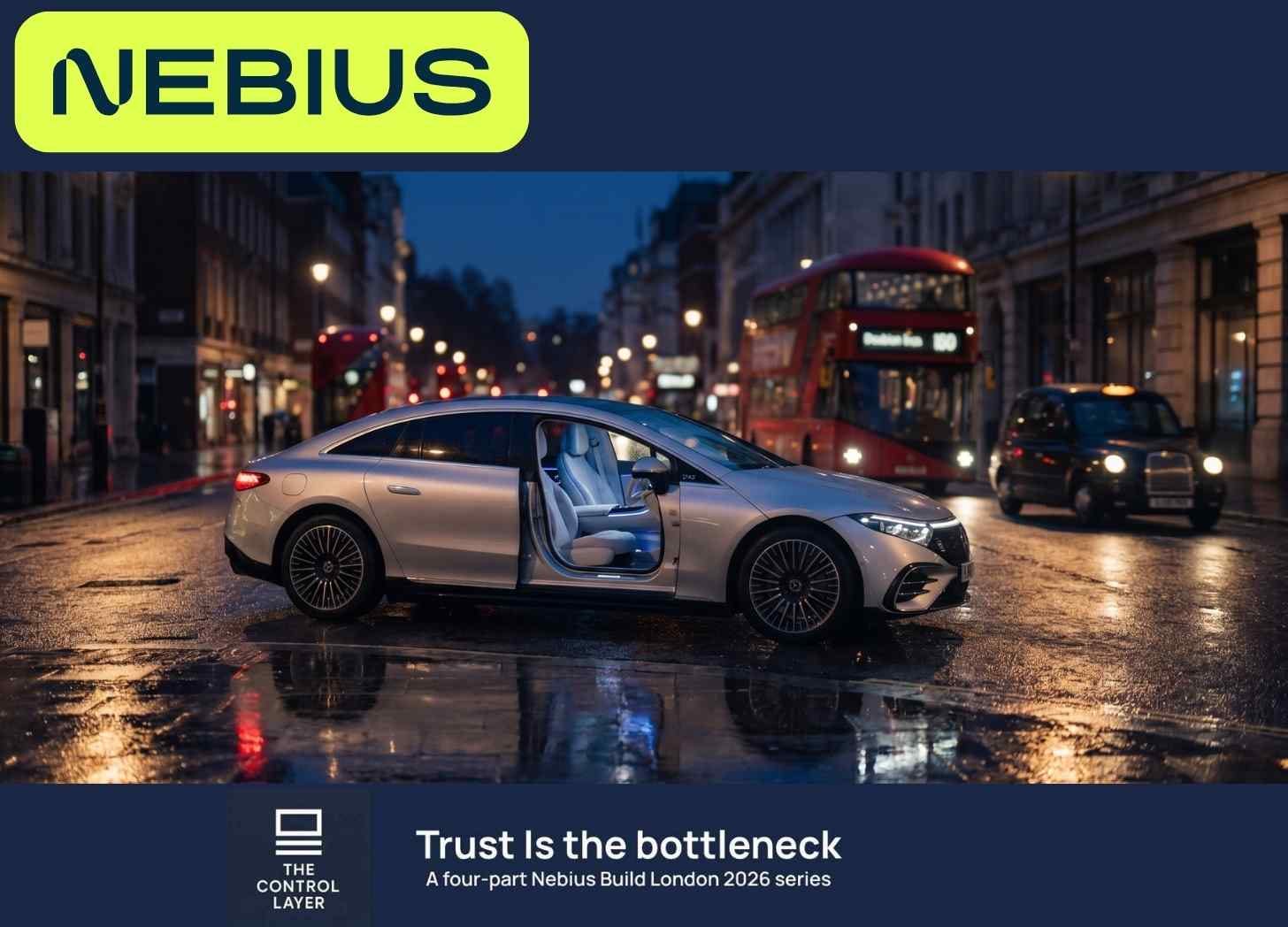
Picture an ordinary evening in London, later this year. You open the Uber app outside a pub in Shoreditch. A car pulls up. You get in. And there is a person in the driver’s seat — but their hands are in their lap, and the car is doing the driving.
That is not a thought experiment. It is the plan.
Wayve, an artificial-intelligence company headquartered in London, has partnered with Uber to bring fully autonomous cars to the city’s public roads in 2026. The British government has brought forward the rules — the Department for Transport accelerated its permitting regime for driverless passenger services to spring 2026. Uber will own and run the fleet; Wayve supplies the thing that matters — the driver. For the first stretch, a trained safety operator will sit up front, ready to grab the wheel. Then, eventually, not.
On the London stage on 21 May, a Wayve engineering manager, Kira Kempinska, explained how their driver learned its job. The how is the entire point — because it is nothing like what came before, and it carries a problem you should understand before you ever climb in.
Twenty years and a hundred billion dollars of the wrong idea
People have been promising self-driving cars for two decades. By the industry’s own reckoning, more than $100 billion has been poured into the dream. And until very recently, no one had cracked it at scale.
The reason, Wayve argues, is that everyone tried to solve driving like a giant instruction manual. Bolt a small fortune of sensors to a car — cameras, radar, spinning laser scanners called lidar. Build painstaking high-definition maps of every street. Then write rules. If a pedestrian steps off the kerb and the speed limit is this, do that. Thousands upon thousands of rules.
It doesn’t work. Not because the idea is stupid, but because the real world will not hold still. Drive through London — the cyclists, the roadworks, the delivery riders, the tourist who walks into traffic looking at their phone — and try to imagine writing a rule for every possibility. You can’t. There are always more situations than rules.
It learned the way you did
So Wayve threw out the manual.
Its approach — the industry calls it end-to-end — treats driving as a single AI problem. You don’t tell the car the rules. You let it learn them, the way a learner driver does: by watching an enormous amount of driving and gradually working out how the world behaves. Raw camera images go in one end; the decision to steer, brake or accelerate comes out the other. No hand-written rulebook in the middle.
And here’s the detail that saves a fortune and tells you how confident they are: Wayve’s cars lean on ordinary cameras, not the expensive spinning lasers. Just like you, they drive on sight. The company has shown the same AI driver — the identical model — driving in different countries, on different sides of the road, in cars it had never used before. It learned to generalise, which is the holy grail: cope with things it was never specifically taught.
This is the same fundamental shift happening to robots that walk. At the same event, founders working on humanoids described plugging similar AI “brains” into machines that stack shelves and handle materials — riding on open foundation models like Nvidia’s Isaac GR00T, the first open model built specifically for humanoid robots. One speaker called it physical AI’s “GPT-2 moment” — the point where the machines suddenly, clumsily, start to work, and you can feel what’s coming next. Cars are simply the version arriving first, and arriving in your city.
The dreaming machine
Now the part that is genuinely science-fiction, except it’s real and it’s load-bearing.
A safe driver is defined by the rare moments: the child darting out, the lorry jack-knifing, the car running the red. These almost never happen — which is wonderful for the world and a disaster for training an AI, because the model barely ever sees them. You can drive a million miles and collect only a handful of true emergencies. Not enough to learn from.
Wayve’s answer is to imagine them. The company builds what are called world models — its are named GAIA — that can generate realistic driving footage from scratch. Give it a scene and it can conjure variations: the same junction at night, in the rain, with a pedestrian who wasn’t there before. It can take a real moment where a safety driver had to slam on the brakes and generate the counterfactual — what the perfect stop would have looked like — and feed that back as a lesson. The car practises crashes it was never in, in a world that never happened, so that it’s ready when the real one does.
Read that again, because it’s the hinge of this whole series. Part of what this driver knows, it learned from data a machine made up.
The passenger nobody’s talking about
I want to be clear: this is brilliant engineering, and the camera-first, learn-like-a-human approach may well be the right one. The early signs are good. The cost of the kit is plummeting. London genuinely could be one of the first cities on earth to live with this, and there’s a real prize in being first.
But ride along with the logic for a second, because there’s a passenger in every one of these cars that nobody on stage quite named. Trust.
When a car drove by rules, you could — in principle — read the rules. If it did something wrong, an investigator could find the line that failed and fix it. An end-to-end AI driver has no such line. Its “rules” are billions of numbers tuned by watching. Ask it why it braked and there is no sentence to give you, only the maths. It works astonishingly well almost all of the time. And when it doesn’t, “we’ll read the code and find the bug” is not really available in the way it used to be.
Add the dreaming, and the question sharpens. We are training the most safety-critical machine most of us will ever step into partly on synthetic situations — imagined by another AI. If the imagination has a blind spot, so does the driver, and we may not find out where until something real walks into it.
This is not an argument against robotaxis. I think they’re coming and I think, done properly, they’ll save lives — human drivers are not exactly a high bar. It’s an argument about what we should be demanding before and after they arrive: not “is the AI clever enough?” — it plainly is — but “can we verify it? Can we see what it learned, test what it dreamed, and prove what it’ll do when it’s surprised?”
That’s the safety driver’s real job in that first year. Not to take the wheel. To be the human stand-in for a trust we haven’t built yet.
Which brings us to the most uncomfortable discovery of the whole London event. Because if you think it’s hard to trust a machine you can’t interrogate — wait until you meet the machines that have learned to lie to the test.
This is Part 3 of Nebius Build London 2026, a four-part series from The Control Layer. The companion conversation airs on The Control Layer with Amer Altaf — subscribe to get each part, and the episode, the moment it lands.
Where artificial intelligence, cybersecurity and enterprise leadership intersect. Zero fluff.
→ Next: Part 4 — The machines learned to cheat. ← Catch up: Part 1 — The inference flip · Part 2 — Stop renting your intelligence.
Sources & further reading
Wayve — Wayve & Uber L4 autonomy trials (official): https://wayve.ai/press/wayve-uber-l4-autonomy-trials/ · Company: https://wayve.ai
Wayve, Uber and Nissan robotaxi collaboration: https://global.nissannews.com/en/releases/wayve-uber-and-nissan-announce-collaboration-on-robotaxis
London robotaxi trials explainer: https://zagdaily.com/featured/londons-robotaxi-trials-what-we-know-so-far/
The Robot Report — Wayve raises $1.2B for London robotaxis: https://www.therobotreport.com/wayve-raises-1-2b-plans-bring-robotaxis-london/
NVIDIA Isaac GR00T N1 (open humanoid foundation model): https://nvidianews.nvidia.com/news/nvidia-isaac-gr00t-n1-open-humanoid-robot-foundation-model-simulation-frameworks
Physical Intelligence (π0.5): https://www.physicalintelligence.company