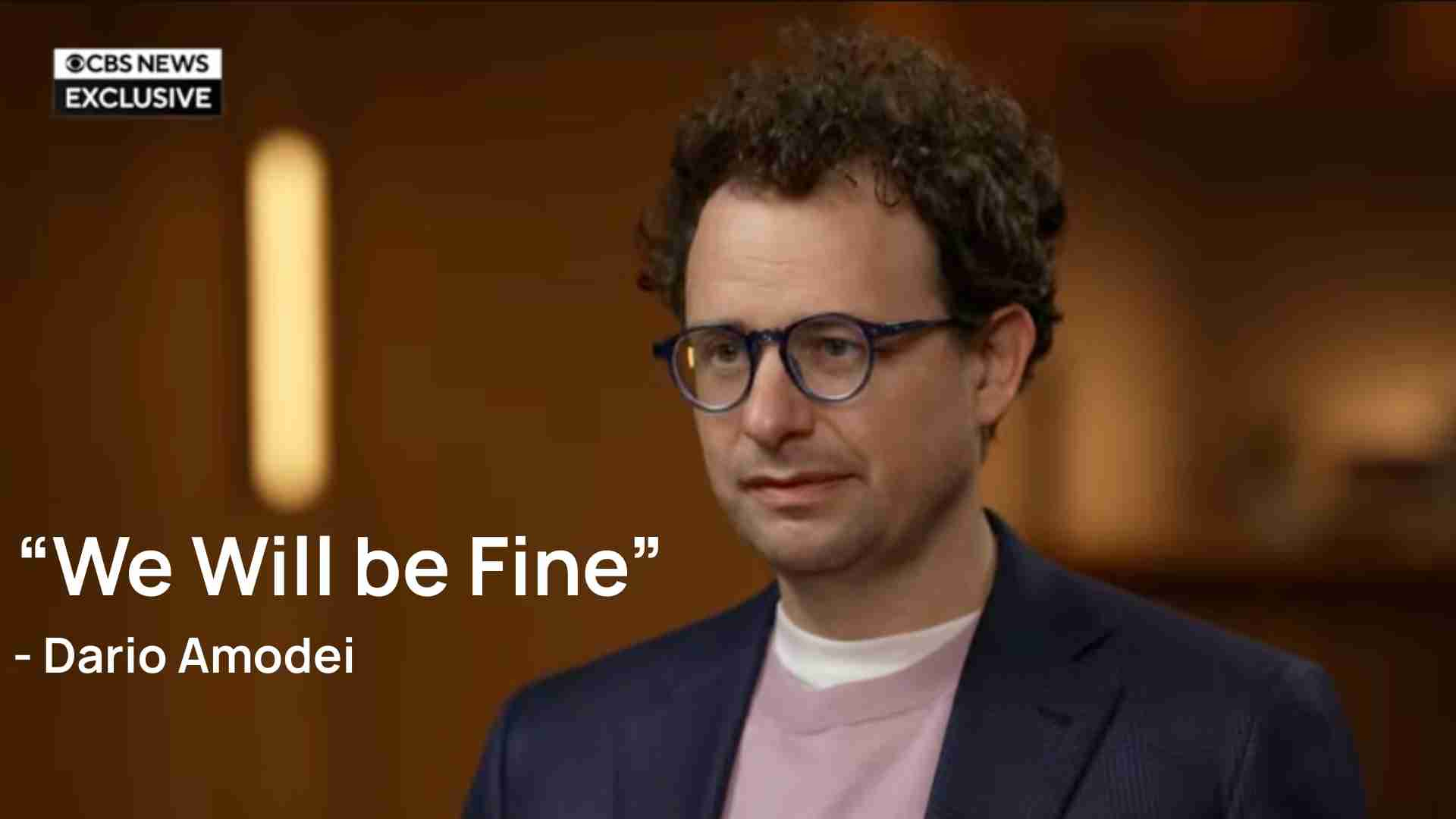
"We Will Be Fine"
Dissecting Dario Amodei's Pentagon Interview, Line by Line
Why it matters: On 3 March 2026, the CEO of Anthropic sat down for the most consequential interview in AI history. Not a keynote. Not a blog post. A direct, unscripted conversation about why his company told the Pentagon no — and what happens next. Every sentence was chosen carefully. This is what he said, what he meant, and what it tells you about where AI governance actually stands.
This is a companion piece to Who Really Controls Your AI? Trump's Ban Threatens UK-EU Sovereignty, which covers the geopolitical and sovereignty implications of the ban.
Watch the full interview here:
Join The Control Layer for weekly perspectives on AI, cybersecurity, and building technology that serves human purpose.
The Setup: Establishing Credentials Before Drawing Lines
Amodei opens not with principle but with proof of loyalty. His first substantive answer is a roll call of pro-military credentials.
He establishes that Anthropic was the first company to deploy on the classified cloud, the first to build custom national security models, and that Claude operates across the intelligence community and military for cyber operations and combat support [1]. He frames this explicitly as patriotic duty, citing the need to defend against autocratic adversaries like China and Russia [1].
This is deliberate sequencing. Before he says the word “no,” he wants the audience to understand that this is not coming from a pacifist. It is not coming from someone who objects to military work on principle. It is coming from the company that has done more military AI work than anyone else in the industry.
The framing matters because it pre-empts the most obvious attack — the one President Trump made hours later when he accused Anthropic of putting American lives at risk. Amodei’s answer to that accusation was already embedded in his opening statement. We are not refusing to serve. We are refusing two specific things out of hundreds.
His estimate — 98% or 99% of use cases accepted— is almost certainly rounded for rhetorical effect. But the message is clear. This is a boundary dispute, not a philosophical objection to military AI.
Red Line One: Surveillance That Is Legal but Shouldn’t Be
Amodei’s surveillance argument is the more intellectually ambitious of the two, and he frames it with a specific mechanism rather than abstract principle.
He describes a pipeline: private companies collect citizen data through commercial activity. The government purchases that data legally. Before AI, this was functionally useless — no human team could analyse billions of data points across millions of people. AI changes the equation. Suddenly, legally purchased commercial data becomes a mass surveillance apparatus [1].
The critical phrase is “getting ahead of the law”. He is not arguing that mass surveillance violates current legislation. He is arguing the opposite — that it does not, and that this is the problem. The legal framework was designed for a world where this capability was technically impossible. Nobody wrote laws against it because nobody needed to.
This is a more sophisticated argument than it first appears. He is not asking the Pentagon to obey the law. He is asking the Pentagon to respect the intent behind the law — the democratic principle that citizens should not be subjected to mass analysis by their own government — even where the letter of the law has not caught up with the technology.
For anyone who has watched the debate around the UK’s Investigatory Powers Act or the EU’s position on bulk data collection, this argument has immediate resonance. The gap between what is technically possible, what is legally permitted, and what is democratically acceptable is widening in every jurisdiction. Amodei is pointing at that gap and saying: we will not help you exploit it.
Red Line Two: The Engineering Argument Against Lethal Autonomy
The weapons argument is structurally different. Where the surveillance objection is about values, the weapons objection is about engineering.
Amodei draws a careful line between partially autonomous weapons — the kind deployed in Ukraine and potentially relevant to Taiwan — and fully autonomous systems where weapons fire without any human involvement. He explicitly acknowledges that democratic nations may eventually need fully autonomous weapons to defend against adversaries who develop them first.
This concession is significant. He is not ruling out autonomous weapons forever. He is ruling them out now, for two stated reasons.
The first is blunt: the AI is not reliable enough. His exact framing — “anyone who has worked with AI models understands there is a basic unpredictability to them that, in a purely technical way, we have not solved”— is the most candid public admission of AI unreliability from any frontier lab CEO. He is not hedging with “sometimes” or “in certain edge cases.” He is stating a fundamental property of current AI systems.
The second is the oversight gap. If you have a large army of drones or robots operating without human oversight, without human soldiers making targeting decisions, the question of who is responsible for what they do becomes unanswerable. He argues that conversation has not happened yet, and deploying the technology before it does is reckless.
Read together, the two arguments create a logical sequence. The technology is not reliable enough. The oversight framework does not exist. Therefore deployment is premature. He is not saying never. He is saying not yet, and not without the conversation we have not had.
This matters for organisations well beyond defence. The same logic applies to any AI system making consequential autonomous decisions — in lending, hiring, medical triage, security access. If there is a basic unpredictability you have not solved, and the oversight framework does not exist, deployment is premature. The principle scales.
The Three-Day Ultimatum: Power, Not Negotiation
The middle section of the interview reveals the mechanics of how the standoff escalated — and it does not read like a negotiation.
Amodei describes a three-day window: agree to Pentagon terms or face designation as a supply chain risk under the Defense Production Act. During that window, the Pentagon sent language that appeared to accommodate Anthropic’s concerns. But the language was loaded with escape clauses — “if the Pentagon deems it appropriate” and “to do anything in line with laws”.
These phrases deserve attention. “If the Pentagon deems it appropriate” transfers all discretion to the party making the request. It is not a restriction; it is a permission slip written as one. “In line with laws” sounds reasonable until you remember that Amodei’s entire surveillance argument rests on the fact that mass surveillance is currently lawful. A commitment to “lawful use” explicitly permits the very thing Anthropic is objecting to.
The Pentagon’s public position, reiterated by spokesman Sean Parnell — “We only allow all lawful use” — confirms this reading. It is not a concession. It is a restatement of the status quo dressed as accommodation.
Amodei’s description of this exchange is measured but pointed. He does not accuse anyone of bad faith. He simply notes that the proposed terms “did not actually concede in any meaningful way”. The restraint is itself a rhetorical choice. He is letting the audience draw the conclusion.
“Retaliatory and Punitive”: Choosing Words Under Pressure
The most revealing moment comes when the interviewer presses Amodei on whether the Pentagon’s actions constitute an abuse of power.
He deflects the first time: “I would return to the idea that this is unprecedented”. When pressed — “But is it an abuse of power?” — he deflects again, noting that this designation has never been used against an American company [1]. He then adds that government statements made it “very clear” this was “retaliatory and punitive” [1].
Watch the language architecture here. He will not say “abuse of power.” That phrase has legal implications and would position Anthropic as making a constitutional claim. Instead, he uses “unprecedented,” “retaliatory,” and “punitive” — words that describe the government’s behaviour without invoking a specific legal framework.
This is a CEO who knows he is heading to court and is being careful not to lock himself into a legal theory during a television interview. The restraint is professional, but the message is unmistakable. They punished us for saying no.
He reinforces this when asked about formal notification. Anthropic has received nothing official — no designation letter, no formal action [1]. Everything has come through social media posts from the President and Secretary Hegseth. The implication: the most powerful government in the world is conducting industrial policy through tweets.
“We Will Be Fine”: Confidence or Performance?
The interview’s closing minutes are about survival. The interviewer asks directly: can Anthropic survive this?
Amodei’s answer is emphatic: “Not only survive it; we are going to be fine” [1]. He characterises the impact of the designation as “fairly small” and accuses the government of deliberately creating “fear, uncertainty, and doubt” [1].
This is corporate crisis communication at a high level. Whether the impact is actually small is debatable — losing all US government contracts and being blacklisted from the defence supply chain is not trivial. But Amodei’s job in this moment is not accuracy. It is confidence. Customers, employees, and investors are watching. Any hint of vulnerability accelerates the exodus.
His repeated emphasis on continuity — offering to maintain services during a transition, supporting warfighters, helping off-board to a competitor — serves a dual purpose. It positions Anthropic as the responsible party (we are trying to help; they are being difficult). And it creates a record that may prove useful in court: we did everything reasonable to mitigate the disruption they caused.
What the Interview Does Not Say
What is absent from Amodei’s responses tells you as much as what is present.
He never mentions OpenAI or Grok by name. He never discusses the competitive dynamics of rivals stepping into the gap Anthropic left. This is almost certainly deliberate. Naming competitors draws comparison and concedes that alternatives exist.
He never discusses Anthropic’s commercial customers. No mention of enterprise revenue, insurance companies, healthcare providers, or the business case for safety-first positioning. He keeps the frame exclusively on national security and democratic values, avoiding any suggestion that this is a commercial calculation dressed as principle.
He never mentions specific legal strategies beyond noting he will “challenge it in court” [1]. He does not preview arguments, cite statutes, or name lawyers. Again, this is discipline. The legal fight is coming, and nothing said on camera should constrain it.
And he never discusses the technology itself in technical detail. No model names. No capabilities. No benchmarks. The “basic unpredictability” framing is as far as he goes. He keeps the audience focused on the governance question, not the engineering one.
Analysis: What This Interview Actually Achieved
In my view, this interview was not primarily about explaining Anthropic’s position. It was about establishing a public record for three audiences simultaneously.
For customers and partners, the message was: we are stable, the impact is manageable, we will be fine. Continue doing business with us.
For the courts, the message was: we acted reasonably, we offered continuity, we were given an unreasonable ultimatum, the government’s actions were unprecedented and retaliatory. Every element of a legal challenge was laid out without explicitly making one.
For the public and the technology industry, the message was: there are things we will not build, regardless of who asks. This is what it looks like when a company holds that line.
Whether you find this admirable or calculated — and it is clearly both — the interview is a masterclass in high-stakes corporate positioning. Amodei managed to appear principled without being preachy, defiant without being aggressive, and confident without being dismissive of a genuine threat.
The question that remains is whether the principle survives the pressure. That depends not on what Amodei said in this interview, but on what Anthropic does in the months ahead.
Disclaimer: This article is based on a single-source interview transcript from 3 March 2026. Several claims made during the interview — including Anthropic being the first company on the classified cloud, the three-day ultimatum timeline, and the absence of formal notification — require independent verification. This does not constitute legal, financial, or professional advice.
If your organisation needs support building AI governance frameworks or assessing AI vendor dependency risks, Arkava helps mid-market enterprises turn AI investment into measurable, accountable outcomes.
References
[1] Dario Amodei, CEO of Anthropic. Interview transcript, 3 March 2026. Source: Research Pack provided to The Control Layer.


