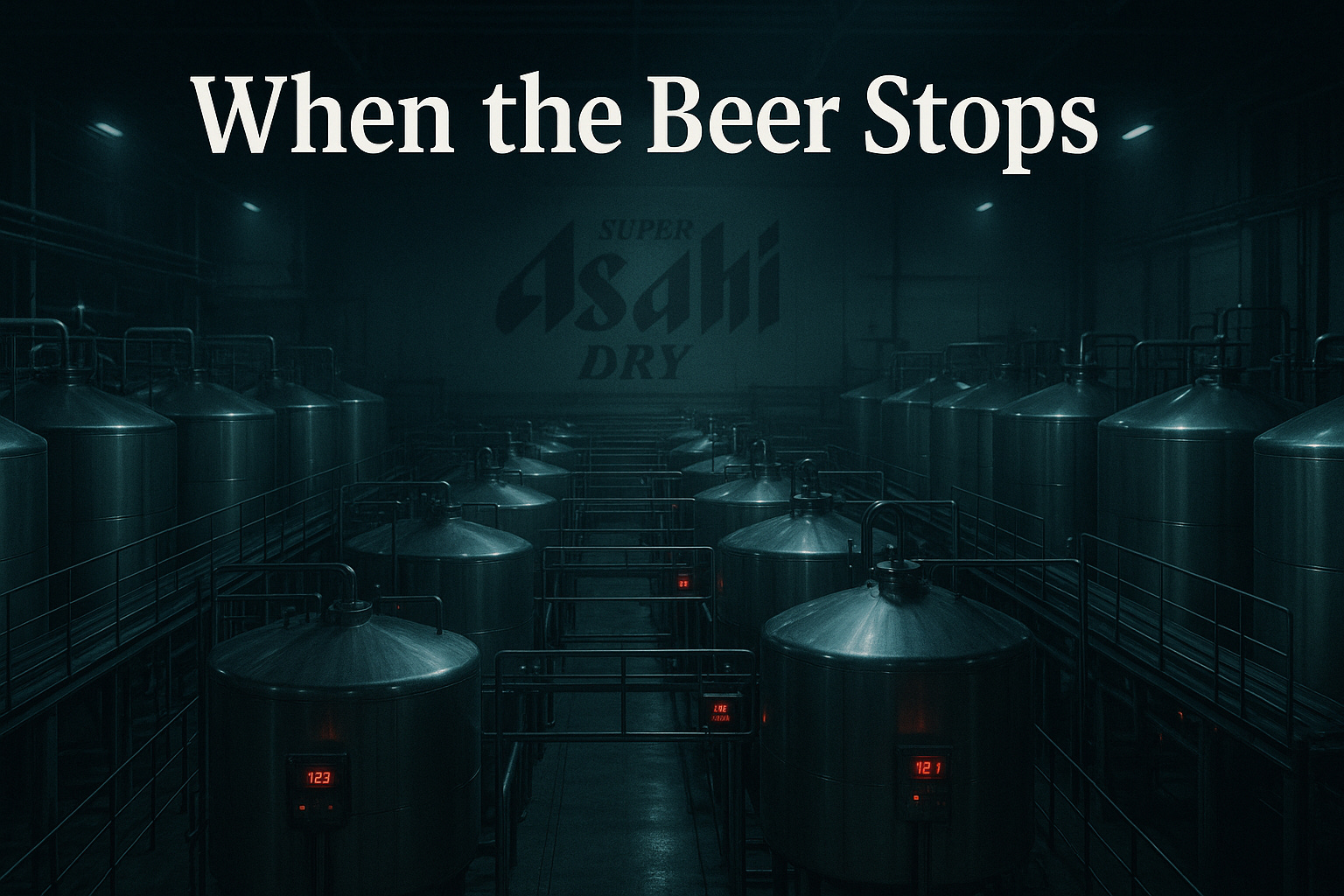
When the Beer Runs Dry: Inside the Asahi Super Dry Cyber Attack
Why it matters
On 29 September 2025, Japan’s largest brewer, Asahi Group Holdings, was hit by a crippling cyber attack that brought its domestic operations to a standstill. With 30 factories offline, shipments halted, and order systems disabled, Japan is now facing the very real prospect of running out of its most popular beer — Asahi Super Dry — within days.
This attack is more than a disruption to pints and parties. It is a showcase of the escalating cyber risks facing global manufacturers, the financial and reputational costs of ransomware, and the vulnerabilities created by integrated IT and operational technology systems.
A Sudden Halt: What Happened
At around 7:00 AM JST on Monday, 29 September 2025, Asahi’s Japanese operations experienced what initially looked like a system failure. By mid-morning, it became clear that this was no accident: the company was the victim of a deliberate ransomware attack.
The attackers hit at the heart of Asahi’s digital backbone — its order processing, logistics, and production scheduling systems. The immediate fallout included:
Suspension of order processing across all Japanese subsidiaries.
Shutdown of shipping and logistics operations.
Paralysis of call centre and customer support functions.
Production halts at most of Asahi’s 30 domestic factories.
By 1 October, Asahi confirmed that most domestic operations remained offline with no recovery timeline in sight. To make matters worse, the company was forced to delay the launch of 12 new products, including non-alcoholic drinks and food items.
The Attack Vector: A Classic but Effective Ransomware Play
While Asahi has not publicly confirmed the attackers’ identity, all indicators point to ransomware:
System-wide encryption locked critical data and applications.
Rapid network propagation across integrated IT infrastructure.
Operational technology (OT) disruption halted production lines.
No ransomware group has yet claimed responsibility, which suggests one of two things: either the criminals are engaged in private ransom negotiations, or they are a newer actor still deciding how to leverage their attack.
The technical pattern mirrors previous attacks on global manufacturers: compromise of credentials (often through phishing or third-party software flaws), escalation of privileges, and lateral movement across flat networks until both IT and OT systems are locked.
This is particularly effective in environments like Asahi’s, where IT/OT convergence means that disruption of digital systems directly translates into halted brewing, bottling, and distribution.
The Financial Impact: Billions at Stake
Asahi reported annual revenue of ¥2.94 trillion ($19.6 billion USD) in fiscal 2024, with half of that generated in Japan. That equates to roughly $26.8 million in daily revenue at risk from the shutdown of domestic operations.
Estimated losses:
1 week outage: $188 million in direct revenue.
2 weeks outage: $376 million.
1 month outage: $805 million.
But these numbers only scratch the surface. When factoring in incident response, forensic investigation, regulatory obligations, reputational fallout, and supply chain impacts, the total cost is likely 3–5 times direct losses. That puts the potential bill at $2.4–$4.0 billion if disruption lasts a month.
For context: that’s in line with the total economic impact of the 2017 NotPetya attack, which brought shipping giant Maersk to its knees and cost the company up to $300 million.
A National Shortage: Supply Chain Shockwaves
Asahi commands around 40% of Japan’s domestic beer market. The sudden halt in production and distribution has had an immediate knock-on effect:
Convenience stores (Lawson, 7-Eleven, FamilyMart) are warning of empty shelves within days.
Supermarkets and retailers report beer stocks could be gone in less than a week.
Restaurants and bars are scrambling to source alternatives, hitting Japan’s hospitality sector at a critical time.
Transport networks shared with rivals like Kirin and Sapporo are experiencing ripple effects.
Asahi produces an estimated 6.7 million large bottles of beer per day in Japan. When that volume disappears overnight, there’s no easy way to replace it.
The public response has been predictable: panic buying. Across Tokyo and Osaka, customers are stockpiling Asahi Super Dry, creating scarcity that amplifies the sense of crisis.
Global Containment: Why Europe and the UK Are Safe (For Now)
One small mercy: Asahi has confirmed that the attack has been contained to Japan. Its European and UK operations remain fully functional, including brands such as Peroni, Pilsner Urquell, Grolsch, and Fuller’s London Pride.
This geographic containment suggests effective network segmentation — a crucial defensive measure that prevented the attackers from moving laterally into international systems. It also raises the possibility that Japan-specific infrastructure was the target, whether by design or due to weaker defences.
The Wider Cybersecurity Context
The Asahi breach is not an isolated case but part of a larger pattern. Japanese corporations are increasingly under fire:
36% of Japanese firms reported cyberattacks in the past year (Teikoku Databank).
DDoS attacks surged 60% year-on-year in late 2024.
Nearly half of ransomware victims in Japan take more than a month to recover.
Manufacturing and food & beverage companies are particularly exposed. They operate with thin margins for downtime and depend on highly integrated, often legacy systems that are difficult to secure.
Similar incidents in 2025 alone include:
Jaguar Land Rover: forced production shutdown after an attack.
Marks & Spencer: £300m profit hit from a cyber incident.
Co-op Group: £80m impact from supply chain disruption.
Attack Patterns and Known Threat Actors
While attribution is ongoing, the attack pattern fits the profile of established ransomware groups such as LockBit, BlackCat (ALPHV), or RansomEXX, who specialise in targeting industrial operations.
The playbook is depressingly familiar:
Initial access: phishing email, compromised VPN, or third-party software flaw.
Credential theft: using tools like Mimikatz to escalate privileges.
Lateral movement: exploiting flat networks to spread across IT and OT.
Encryption and exfiltration: locking files while stealing data to double the pressure.
Extortion: demand ransom under threat of data leak and operational paralysis.
Given Asahi’s global footprint, the attackers likely view the company as a high-value target capable of paying a large ransom.
Strategic Lessons for Security Leaders
The Asahi attack underscores several critical lessons:
1. IT/OT Segmentation Is Essential
Brewing plants, bottling lines, and logistics systems must be segmented from corporate IT. Flat networks are a gift to attackers.
2. Ransomware Resilience Must Be Tested
Backups are useless if they can’t be restored quickly under pressure. Regular red-team exercises simulating ransomware should be standard.
3. Supply Chain Cyber Risk Cannot Be Ignored
Manufacturers must assess not just their own security posture, but that of transport partners, vendors, and third-party providers.
4. Incident Response Must Be Board-Level
When production stops, the CEO, CFO, and board will be the ones answering to regulators, investors, and the public. Cyber risk is a business risk.
Regulatory Implications
Japan has historically lagged the EU and UK in mandating cyber resilience standards for critical industries. That may be about to change.
Following incidents of this scale, regulators may push for:
Mandatory incident reporting within set timeframes.
Standards for operational resilience, similar to the EU’s NIS2 Directive.
Stricter supply chain security requirements for large manufacturers.
For international firms, this points to an increasingly complex regulatory patchwork, where compliance requires tracking and aligning to multiple jurisdictions.
The Road Ahead for Asahi
As of 2 October, Asahi has provided no clear timeline for recovery. Cyber forensic investigations are ongoing, and the possibility of ransom negotiations looms.
In the meantime:
Panic buying continues in Japan.
Beer stocks dwindle with each passing day.
Brand reputation takes a hit, even as global operations remain untouched.
For Asahi, the final cost will be measured not just in lost revenue but in trust — from customers, shareholders, and regulators. For the rest of the world, it’s a sobering reminder that in a hyperconnected economy, a few lines of malicious code can stop the taps from flowing.
Conclusion
The cyber attack on Asahi is a case study in modern risk. It combines the financial scale of ransomware, the operational fragility of manufacturing, and the social impact of disrupting a cultural icon.
The implications go beyond beer. They speak to the urgent need for resilient IT/OT architectures, tested recovery plans, and stronger regulatory frameworks.
As with Maersk, Norsk Hydro, and Colonial Pipeline before it, the Asahi incident will be remembered as a turning point — where a cyberattack wasn’t just a technical event, but a national crisis.


