Robots, Wombs, and Wheat: China’s Dual-Track Bet on Biotech and Automation
China’s World Robot Conference showed two paths: a proven plant‑breeding robot and a contested surrogate‑pregnancy robot—promise and ethical risks.
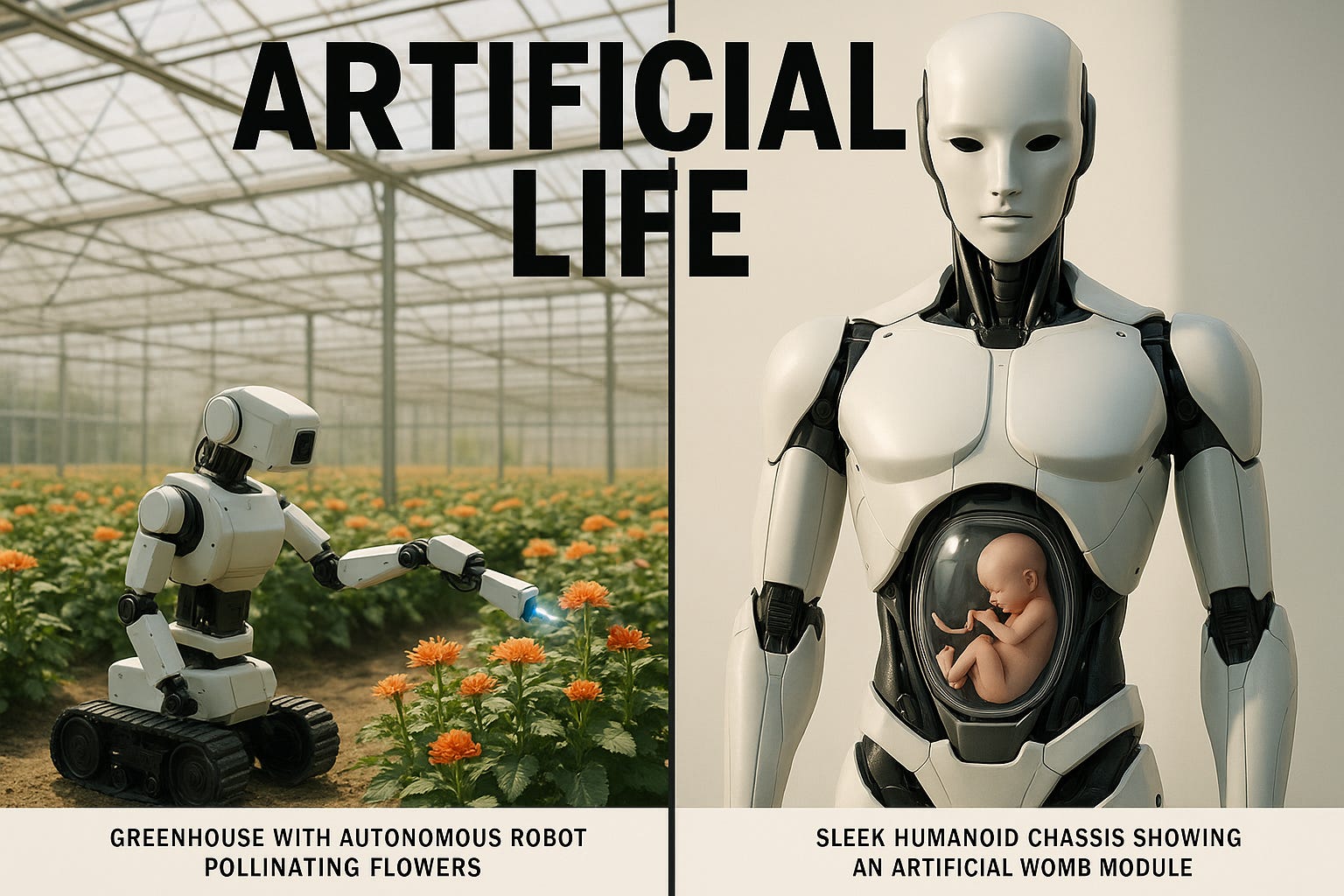
At first glance, the headlines read like science fiction. In Beijing, Chinese researchers presented GEAIR, an AI-driven “full‑process” plant-breeding robot that navigates greenhouses, identifies flowers, and executes precise cross‑pollination. In parallel, a Guangzhou startup drew global attention by claiming it will unveil a humanoid “surrogate pregnancy robot” with an integrated artificial womb within a year at roughly 100,000 yuan—framed as a path to gestation without human pregnancy.
Stack these together and you get a compelling narrative: AI and robotics stepping into biology’s most intimate and labor‑intensive domains. Yet the evidentiary footing for the two stories differs sharply. The plant-breeding robot has been reported by China’s major state and semi-state outlets with technical specifics and references to peer‑review publication. The pregnancy robot is, so far, a media claim—newsworthy, yes, but one that sits atop significant scientific, regulatory, and ethical hurdles.
This article separates what’s verified from what’s speculative, then explores the implications for agriculture, demographics, and governance.
What’s real: a full‑process AI breeding robot for crops
Chinese media describe GEAIR as the world’s first “full‑process” plant-breeding robot—meaning a system that can autonomously navigate greenhouse aisles, detect target flowers at the right developmental stage, and perform precise pollination. Reports cite the Institute of Genetics and Developmental Biology at the Chinese Academy of Sciences (IGDB, CAS) and name researcher Xu Cao as a lead, with mentions that the work is published in Cell and that early deployments focus on high‑value breeding contexts like soybeans. Coverage in CGTN, Xinhua’s English “China Focus,” and ECNS independently frames GEAIR as a step change from experience‑driven breeding to precision, data‑driven workflows that reduce manual labor while improving efficiency and success rates, especially for challenging crosses and male sterile lines.
If you’ve ever watched crop breeders work a greenhouse, you’ll appreciate the pain point. Human technicians spend hours inspecting floral morphology, tracking receptive windows, bagging blooms, and moving pollen—tasks that demand dexterity, timing, and stamina. Mistimed pollination or missed flowers translate directly into delays and lower yields of candidate hybrids. A robot that can see, decide, and act within the narrow temporal window of stigma receptivity—while logging data and outcomes—has obvious value in breeding stations and university plots. If the platform supports fine motor control, consistent positioning, and high‑precision vision, it can standardise tasks that are otherwise variable across technicians and seasons.
Two caveats are prudent. First, the precise performance metrics—pollination success rates, throughput per hour, error rates across species—depend on the peer‑review details. Those numbers will ultimately decide where GEAIR is economically justified and where it is not. Second, win rates in soybeans (where stigma exsertion and male sterility lines pose constraints) do not automatically translate to crops with very different floral architectures. Even so, the direction of travel is clear: as perception and manipulation improve, greenhouse breeding starts to look like an autonomous factory line rather than artisanal craft.
What’s aspirational (and controversial): a “surrogate pregnancy robot”
The second story—of a humanoid robot carrying an integrated artificial womb to gestate a fetus through a full term—has generated both fascination and skepticism. Multiple outlets report that entrepreneur‑researcher Zhang Qifeng and Kaiwa Robot Technology plan to introduce a “pregnancy robot” within a year, targeting an entry price near 100,000 yuan. Coverage notes prior animal artificial‑womb experiments and positions the concept as benefiting people who want children without undergoing pregnancy. The topic reportedly trended heavily on Chinese social media, reflecting both hope and alarm.
There are reasons to treat this announcement as an early claim rather than an established capability. First, the global research community operates under strict ethical and legal limits. Many jurisdictions draw a hard line at 14 days of in vitro embryo development. Moving from that boundary to full‑term extra‑uterine gestation (EUG) in humans would require transformative advances across uterine environment simulation, nutrient and gas exchange, immune interface, infection control, and biophysical mechanics—not to mention a regulatory framework that simply does not yet exist. Reporting from ECNS explicitly notes expert criticism and feasibility questions, and earlier international coverage of China’s “robot nanny” embryo‑care concept emphasised that the two‑week limit is a hard constraint on human embryo work.
Second, the leap from neonatal support (like advanced incubators or experimental “biobag” systems for very premature lambs) to true ectogenesis—gestation from conception to birth outside the human body—is non‑incremental. It moves from supporting partially developed lungs and organs to recapitulating the entire uterine milieu, placenta‑like exchange, endocrine signalling, and mechanical forces that guide morphogenesis. Even animal models for complete ectogenesis remain research‑grade; translating to humans would trigger profound regulatory scrutiny. The reporting so far does not provide peer‑review details, preclinical milestones, or a validated clinical pathway—hallmarks we’d expect ahead of any market launch.
Given those gaps, the cautious stance is to document the claim, note public interest and price/timeline assertions, and balance it with expert concerns and applicable legal limits. That approach respects the news value without overstating readiness.
Why these two stories emerged together
It’s no accident these announcements coincided with a major robotics showcase. China has prioritised robotics and automation as strategic sectors, measured both by patent volume and industrial output. A high‑visibility conference is the ideal stage to surface frontier narratives that signal ambition: robotics touching food security (a perennial strategic concern) and demographics (amid a prolonged decline in birth rates). The agricultural robot story fits neatly into a long arc of precision agriculture and food resilience; the artificial womb claim, even if immature, captures the imagination around how technology might reshape reproductive choices in a society wrestling with ageing and labour supply.
For CTOs and R&D leaders, the pattern matters more than any one device: AI perception pipelines, mobile manipulation in semi‑structured environments, and cyber‑physical systems that close the loop from sensing to actuation in biologically sensitive contexts. The greenhouse is a near‑term proving ground where marginal gains convert into tangible ROI. The artificial womb, by contrast, frames the edge case that will force new standards, safety protocols, and bioethics governance long before viable systems exist.
What changes if GEAIR‑style robots scale?
Standardised breeding workflows: Robots can impose consistent protocols across sites and seasons, improving reproducibility of crosses and data capture for genotype–phenotype mapping.
Throughput and time-to-variety: If pollination windows are exploited more completely and error rates fall, pipeline cycle times shrink. In climate‑stressed contexts, that’s strategic.
Labour reconfiguration: Skilled breeders shift from manual pollination to experiment design, parameter tuning, and QA oversight—higher‑leverage tasks that pair domain expertise with machine capability.
Data as an asset: Vision and actuation logs become part of the breeding dataset, enabling new analytics on floral development timing, environmental interactions, and success predictors.
Risks include monoculture of tooling (over‑reliance on a single platform), brittleness across crop species, and the usual MLOps challenges of maintaining vision models under drift as greenhouse conditions change. These are solvable engineering problems—especially if vendors expose APIs, version models responsibly, and support task‑specific fine-tuning.
What changes if artificial womb tech ever crosses key thresholds?
Here, we deal in hypotheticals—but they are worth naming because they shape policy and research governance today.
Regulatory architecture: Any move beyond embryo culture limits would demand a multilateral reframing of laws governing gestation, embryo research, and parental rights. In most countries, that process takes years and involves parliamentary debate, expert panels, and public consultation.
Clinical validation and liability: The bar for safety is extraordinarily high. Endpoints would span survival, developmental outcomes, and long‑term health. Liability frameworks for device makers, clinicians, and guardians would need explicit definition—well beyond today’s medical device norms.
Equity and access: Even if technically feasible, pricing, reimbursement, and access could entrench disparities unless deliberately addressed. The reported 100,000 yuan target, if real, says little about total cost of care, clinical supervision, and legal overhead.
Societal impact: Questions of identity, gestational labour, and family structures are not mere “comms challenges.” They are core ethical issues that require pluralistic, cross‑cultural deliberation.
It is possible—and prudent—to decouple these debates from the immediate, practical promise of neonatal care innovation, maternal health support, and fertility treatments. Conflating them can distort policy.
Signals to watch in the next 12–18 months
Peer‑review artefacts for GEAIR: DOI, supplementary videos, datasets, and cross‑crop trials. If the platform shows robust performance beyond soybeans, it’s a category setter.
Vendor ecosystem: Competing pollination/breeding robots from other institutes or startups; interoperability with greenhouse management systems and phenotyping rigs.
Reproductive tech transparency: Any public release of preclinical data, ethics board filings, or regulatory consultations related to artificial womb claims. Absence of these would argue for caution.
Policy movement: If any jurisdiction signals review of embryo research limits or issues discussion papers on ectogenesis, expect intensified scrutiny and stakeholder mobilisation.
Bottom line
Verified progress: China’s GEAIR signals real, near‑term impact in agricultural R&D, with state media detailing capabilities and a peer‑review anchor cited. It is credible, strategically relevant, and aligned with precision agriculture’s trajectory.
Speculative frontier: The humanoid surrogate pregnancy robot remains an unproven claim that collides with current science and law. It merits attention but demands rigorous skepticism until peer‑reviewed evidence and regulatory pathways appear.
Both stories illuminate how AI and robotics are moving from the factory floor into living systems. In the greenhouse, that shift is already creating measurable efficiency. In the clinic, it is still a thought experiment wrapped in provocative hardware. As these arcs unfold, the imperative for technologists, policymakers, and the public is the same: keep the bar for evidence high, expand the circle of stakeholders early, and design governance with the same ingenuity we bring to machines.


