Ransomware and Data Theft Surge: Four Major Incidents Expose Critical Vulnerabilities
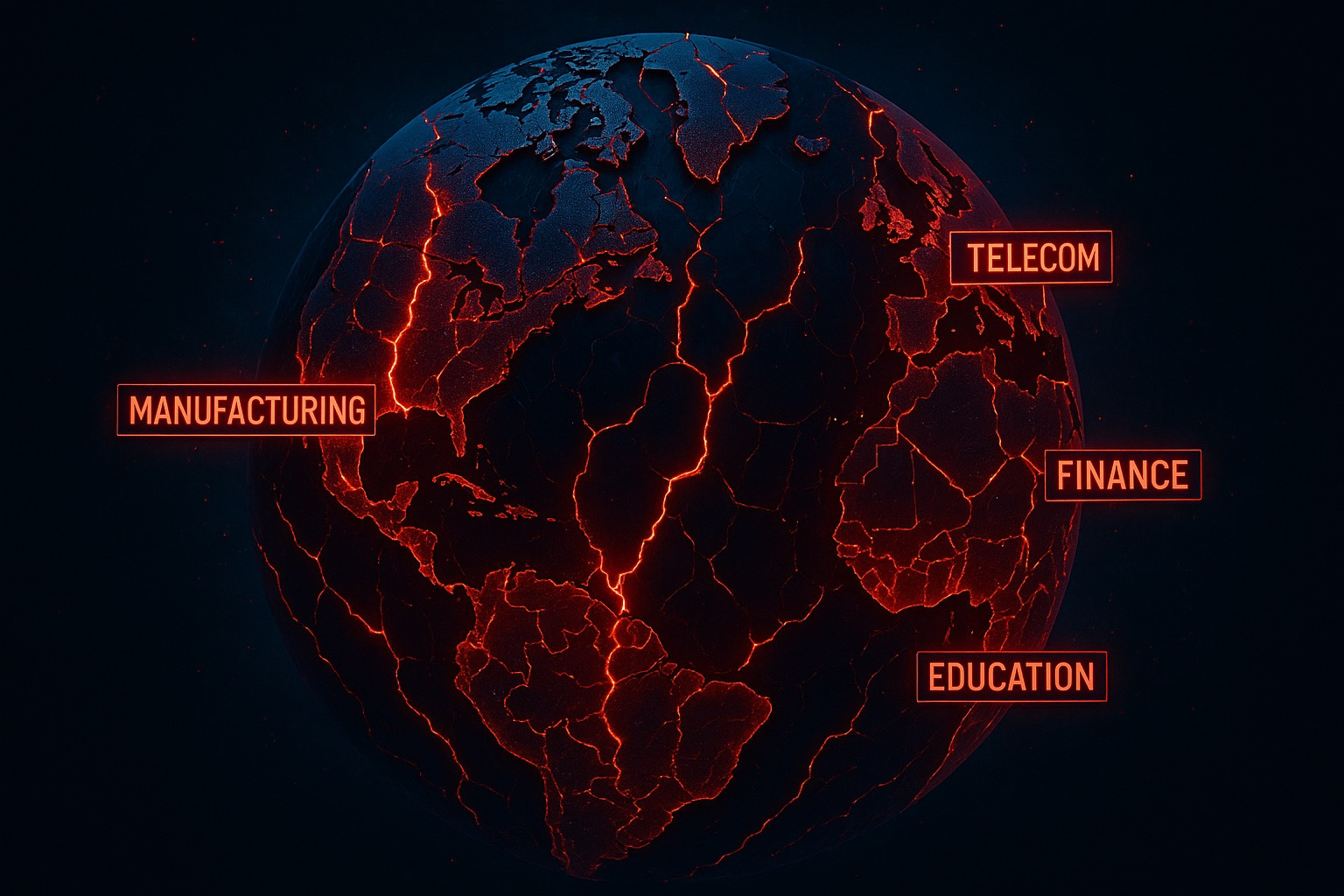
The cyber battlefield is no longer confined to the shadows. In mid-2025, four seismic breaches shook confidence in the digital resilience of critical sectors: Royal Enfield in manufacturing, Colt Technology Services in telecommunications, Columbia University in higher education, and Connex Credit Union in financial services. Nearly one million individuals were affected, and several enterprises were paralysed.
These incidents demonstrate a disturbing trend. Cybercriminal groups — often backed or tacitly tolerated by states — are evolving beyond smash-and-grab tactics. Instead, they deploy zero-day exploits, hybrid ransomware, and politically motivated data theft with surgical precision. The result is a blurring of boundaries between organised crime, hacktivism, and geopolitical manoeuvring.
Royal Enfield: Zero-Day Breach in the Heart of Manufacturing
On 12 August 2025, Royal Enfield, the 124-year-old motorcycle brand, faced an existential crisis. Attackers exploited a zero-day flaw in its VPN gateway, breaching the network with what analysts dubbed a “nuclear-grade” assault.
Inside, they unleashed a devastating toolkit: AES-256-CBC encryption, a PowerShell-based “nuclear wiper” to erase backups, and Mimikatz for credential theft. Data was siphoned off via steganographic exfiltration, embedding stolen files inside innocuous-looking images.
The operational fallout was immediate. Production lines halted worldwide, online dealer portals went dark, and repair services were suspended. Attackers demanded payment within 12 hours — while simultaneously running private auctions for stolen data via qTox and Telegram.
Attribution remains murky, but investigators suspect a collaboration between ShinyHunters and Scattered Spider — two groups known for increasingly professionalised cooperation.
Colt Technology Services: WarLock’s SharePoint Siege
The same day, Colt Technology Services, a major UK telecoms firm, fell victim to the WarLock ransomware group.
The entry point was the now-infamous ToolShell exploit chain, a pairing of Microsoft SharePoint zero-days (CVE-2025-53770 and CVE-2025-53771). By crafting malicious HTTP POST requests, WarLock actors gained remote execution and bypassed authentication.
WarLock, a Ransomware-as-a-Service (RaaS) group that only emerged in June 2025, operates with theatrical bravado. Their slogan: “If you want a Lamborghini, please contact me.” Behind the bravado lies serious capability. Post-exploitation techniques included Group Policy Object manipulation, Cloudflare binary renaming, and RClone data theft disguised as security software.
The haul? Several hundred gigabytes of contracts, employee salary files, and executive data. Instead of issuing a ransom, WarLock auctioned the loot privately for $200,000 — a move away from the traditional hostage model towards market-driven monetisation.
Colt’s services — including its customer portal and voice API platform — remained offline for over a week. The group’s suspected ties to China’s Storm-2603 actor reinforce fears of geopolitical overlap in ransomware ecosystems.
Columbia University: Hacktivism Meets Academia
On 24 June 2025, Columbia University disclosed a breach affecting 868,969 individuals. Unlike pure profit-driven attacks, this was politically motivated.
The attacker had maintained covert access for more than two months, exfiltrating 460GB of sensitive data, including Social Security numbers, admissions records, health data, and financial aid information. Alarmingly, 1.8 million Social Security numbers tied to employees and family members were also compromised.
The hacker, styling themselves as a “hacktivist,” claimed the operation aimed to scrutinise Columbia’s compliance with the 2023 Supreme Court ruling against affirmative action. Portions of application data were leaked to Bloomberg, creating a politically charged storm that blended data theft with cultural warfare.
For Columbia, the repercussions were both operational and reputational. Beyond offering two years of credit monitoring, the university faces class-action lawsuits and scrutiny under state data laws for delayed disclosure.
This case exemplifies the rising phenomenon of ideological cyberattacks: not driven by money, but by influence, disruption, and narrative control.
Connex Credit Union: Banking on Breach Detection
On 3 June 2025, Connecticut’s Connex Credit Union spotted “unusual activity” on its network — barely 24 hours after the intrusion. While the quick detection was commendable, the investigation dragged until late July, when 172,000 members learned their data had been stolen.
Exposed details included Social Security numbers, account numbers, debit card information, and IDs. Connex maintains no accounts were directly drained, but the stolen identifiers are ripe for identity theft and fraud.
The attack coincided with ShinyHunters’ vishing campaigns, though no actor has claimed responsibility. For Connex, the breach came amid broader financial sector turbulence, with multiple US institutions reporting similar hits.
The credit union offered a year of credit monitoring and worked with federal authorities, but the timing highlights the regulatory challenges facing smaller financial institutions — often less resourced, yet still lucrative targets.
Patterns Emerging: Hybrid Ransomware and Market-Driven Data Theft
These four cases illustrate the shifting nature of the ransomware economy:
Zero-day exploitation is no longer the preserve of state actors. Both Royal Enfield and Colt were breached by vulnerabilities weaponised almost immediately after disclosure.
Hybrid tactics — encryption plus theft, plus backup destruction — leave victims paralysed and regulators scrambling.
Private auctions for stolen data bypass direct ransom negotiations. WarLock and others see less reputational risk in dealing with secondary buyers than with their victims.
Hacktivism is no longer a fringe activity. Columbia’s breach showed how ideological agendas can weaponise personal data to amplify political disputes.
Strategic Implications: A Watershed in Cybersecurity
What distinguishes mid-2025’s breach wave is not just the scale, but the coordination and diversity of the attacks. Manufacturing paralysis, telecoms disruption, academic politicisation, and financial compromise all converged within weeks.
This convergence suggests:
Attackers are watching disclosure cycles closely. The ToolShell exploit spread across 145 organisations in 41 countries within days.
State-linked and criminal groups are collaborating. Evidence of ShinyHunters and Scattered Spider sharing tactics underscores how adversaries pool resources.
Critical infrastructure is the prime target. These are not opportunistic hits but carefully chosen strikes on sectors and companies whose disruption cascades widely.
The geopolitical context cannot be ignored. China-linked groups like Storm-2603 play an increasingly active role, while politically charged hacktivists exploit societal divisions. Financial motivations, ideological agendas, and statecraft are becoming indistinguishable threads in the cyber threat tapestry.
The Road Ahead: What Must Change
These breaches serve as a wake-up call. Critical infrastructure operators and regulators must urgently rethink their approaches:
Rapid patching and zero-day readiness. Delays of days, not weeks, now spell disaster.
Resilient backups and redundancy. Offline and immutable storage is critical against “nuclear wipers.”
Intelligence-led defence. Cross-sector threat sharing is no longer optional. Telecoms should learn from manufacturing, universities from banks.
Regulatory muscle. Without consistent disclosure standards and meaningful penalties, institutions will continue to under-report and delay.
As one senior threat analyst told me this week:
“We are no longer fighting amateurs with ransomware kits. We are facing professional adversaries treating cybercrime as enterprise — and geopolitics as their shield.”
Final Thoughts
The ransomware and data theft surge of 2025 may be remembered as a watershed moment. Not because any one company or university fell, but because four different pillars of modern life were struck in quick succession.
Motorcycles, telecoms, education, and finance — sectors symbolic of culture, connectivity, knowledge, and security — all exposed their digital fragility.
If these attacks demonstrate anything, it is this: resilience is no longer optional. It is existential.


