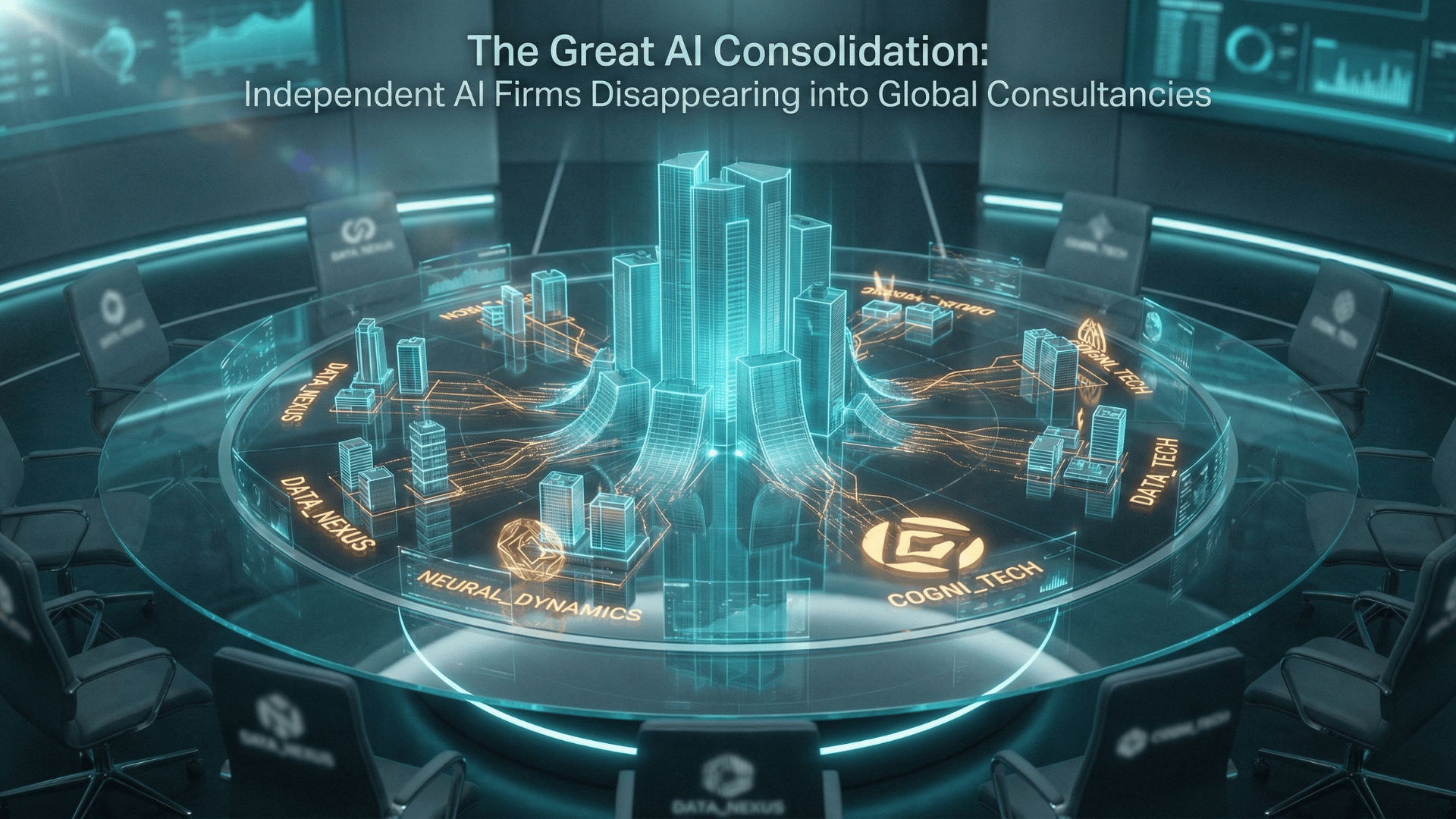
The Great AI Consolidation
What Accenture's £500M Faculty Deal Means for Your AI Strategy
Why it matters: Accenture's acquisition of Faculty – the UK's most prominent AI-native firm – is not an isolated deal. It is the twenty-third AI acquisition Accenture has completed in 2025 alone, part of a broader consolidation wave that includes Microsoft's $250 billion restructuring of its OpenAI relationship. For mid-market organisations still experimenting with AI, the message is stark: the builders are being bought, the infrastructure is being locked in, and the window to establish independent AI capability is narrowing fast.
Join The Control Layer for weekly perspectives on AI, cybersecurity, and building technology that serves human purpose.
The acquirers are buying the builders
Faculty was, until last week, the closest thing the UK had to a sovereign AI consultancy with genuine government-grade credentials. Founded in 2014, it built its reputation on applied AI for the UK public sector, defence, and regulated industries. Its work with the NHS during COVID-19 and subsequent defence contracts established it as the go-to firm when UK organisations needed AI capability they could trust [1].
Accenture paid approximately £500 million for that trust. The acquisition follows a pattern that should concern every mid-market technology leader in the country: the large consultancies and hyperscalers are systematically absorbing the independent AI talent pool [2].
This is not speculation. Accenture alone has completed twenty-three AI-related acquisitions in 2025, building what amounts to a vertically integrated AI services empire [2]. Meanwhile, Microsoft’s $250 billion restructuring of its OpenAI partnership signals that even the largest technology relationships are being reconfigured around AI infrastructure ownership [3].
The pattern is unmistakable: enterprise AI is moving from the experimentation phase to the infrastructure phase, and the infrastructure is being consolidated into fewer, larger hands.
What consolidation actually means for mid-market organisations
When a firm like Faculty gets acquired, the immediate press coverage focuses on the deal value and the strategic rationale for the acquirer. What rarely gets discussed is the downstream effect on the organisations Faculty used to serve directly.
Three things happen when independent AI capability gets absorbed into a global consultancy.
First, pricing changes. Faculty’s mid-market clients could access genuine AI expertise at rates that reflected a 200-person specialist firm. Those same capabilities, delivered through Accenture’s engagement model, come with enterprise pricing, minimum contract sizes, and overhead structures designed for FTSE 100 clients, not £50 million revenue businesses.
Second, attention shifts. Global consultancies serve global clients. The bespoke attention that a mid-market UK manufacturer received from Faculty’s team will, inevitably, compete for resources against larger, more profitable engagements. This is not a criticism of Accenture’s intentions – it is a structural reality of how large professional services firms allocate talent.
Third, and most significantly, dependency deepens. When the independent options disappear, mid-market organisations have fewer choices. Build capability internally, pay enterprise rates to the consolidators, or do nothing and fall further behind.
The 75% failure rate makes this worse, not better
Here is where consolidation intersects with a problem the industry has been quietly ignoring. Industry benchmarks consistently show that 75% of AI investments fail to deliver measurable business value [4]. That statistic predates the current consolidation wave. It describes a market where organisations had more choice, more independent advisers, and more competitive pressure on implementation quality.
Consolidation does not inherently solve the value delivery problem. In some cases, it exacerbates it. When fewer providers control more of the market, the competitive incentive to tie fees to outcomes diminishes. Why guarantee results when clients have limited alternatives?
The architecture, engineering, and construction sector provides a useful case study. This week’s data shows 74% AI adoption across AEC firms, a figure that sounds impressive until you examine what “adoption” means in practice. For many organisations, adoption means purchasing licences and running pilot projects. It does not mean delivering measurable operational improvement. The gap between AI adoption and AI value is where most organisations lose money, and consolidation makes that gap harder to close.
Analysis
In my view, this consolidation wave represents the most significant structural shift in the UK AI services market since the original cloud migration era of 2015-2019.
The parallel is instructive. During cloud migration, mid-market organisations that moved early and built internal competence ended up with genuine flexibility and competitive advantage. Those that waited and relied entirely on external providers found themselves locked into expensive, inflexible arrangements that took years to unwind.
AI capability is following the same trajectory, but faster. The firms that could have helped mid-market organisations build independent AI competence are being absorbed into structures designed to serve enterprise clients. The talent pool is not growing fast enough to replace them. And the technology itself is advancing at a pace that makes delayed action increasingly expensive.
The simultaneous launch of Claude Opus 4.6’s multi-agent orchestration, OpenAI’s Frontier enterprise service, and Mistral’s on-device models in a single week illustrates the acceleration. These are not incremental updates. They represent fundamental shifts in what AI systems can do autonomously. Organisations that lack the internal capability to evaluate, implement, and govern these tools will find themselves dependent on whoever can – and after this consolidation wave, the “whoever” is an increasingly small group charging increasingly large fees.
The EU’s decision to delay high-risk AI compliance deadlines [5] adds another dimension. Regulatory uncertainty benefits large organisations with dedicated compliance teams. It penalises mid-market firms that were counting on clear regulatory timelines to plan their AI governance investments. Every delay extends the period of ambiguity, and ambiguity favours those with the deepest pockets.
Risks and constraints
The consolidation narrative has legitimate counter-arguments. Large consultancies bring scale, methodology, and risk management capabilities that smaller firms cannot match. Accenture’s acquisition of Faculty may genuinely improve the quality and reliability of AI delivery for some clients, particularly in defence and high-security environments where Accenture’s global compliance infrastructure adds value.
There is also a talent argument. Faculty’s engineers may have more career development opportunities within a global firm, which could improve retention and attract stronger candidates. Better talent, in theory, means better outcomes for clients.
However, these benefits accrue primarily to large enterprise clients. For mid-market organisations, the risk profile is weighted differently. The critical constraint is time: the window to build internal AI capability while independent advisory options still exist is measurably shorter after this week than it was before.
It is also worth noting that Faculty’s government contracts introduce sovereignty considerations. UK defence and public sector AI capability is now partially owned by a US-headquartered consultancy. Whether this matters depends on one’s view of sovereign technology requirements, but it is a factor that boards in regulated sectors should consider.
What to do next
For boards and executives: Commission an honest assessment of your organisation’s AI capability dependency. Map every external AI provider relationship and ask: if our primary provider doubled their rates or shifted focus to larger clients, what would we do? If the answer is “nothing, because we have no alternatives,” that is your strategic risk. This quarter, not next year.
For technical leaders: Evaluate the build-versus-buy equation with fresh assumptions. The cost of building internal AI capability has decreased significantly with open-source models and platforms. The cost of external dependency has increased and will continue to increase as consolidation reduces competition. Run the numbers again – the answer may have changed.
For mid-market organisations: Consider whether outcome-based AI partnerships – where fees are tied to measurable business results rather than time and materials – offer a structural solution to the consolidation problem. Providers willing to guarantee outcomes have a fundamentally different incentive structure from those selling capacity. In a consolidating market, aligned incentives become your most important procurement criterion.
Disclaimer: This article represents analysis based on publicly available information as of February 2026. It does not constitute legal, financial, or professional advice.
If your organisation needs support building independent AI capability before the consolidation window closes, Arkava helps mid-market enterprises turn AI investment into measurable business outcomes – with pricing tied to results, not billable hours.
References
[1] Faculty AI. Company background and UK public sector portfolio. faculty.ai, 2026. [2] Accenture. AI acquisition programme; Faculty acquisition announcement, February 2026.
[3] Microsoft-OpenAI. Partnership restructuring and $250 billion investment framework, February 2026.
[4] Industry benchmark data. AI investment value realisation rates across enterprise deployments.
[5] European Commission. EU AI Act high-risk compliance timeline adjustment, February 2026.


