

Four chokepoints: inside the fortnight that made European technology sovereignty unavoidable
From the Strait of Hormuz to ASML in Eindhoven, four supply chains failed in fourteen days and the board papers being written this month still treat it as an oil shock. Part one of a five-part series.

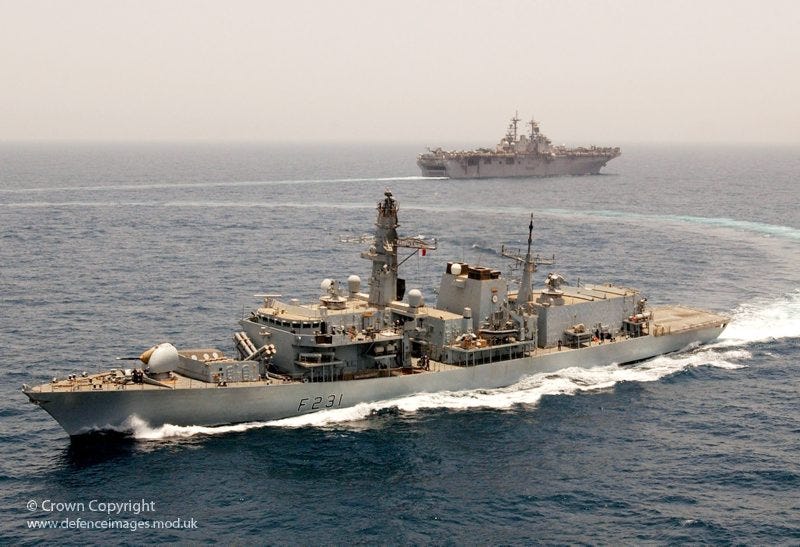
On the morning of 8 April, somewhere between the Strait of Hormuz and a Dutch lithography plant in Veldhoven, four supply chains began to fail at once.
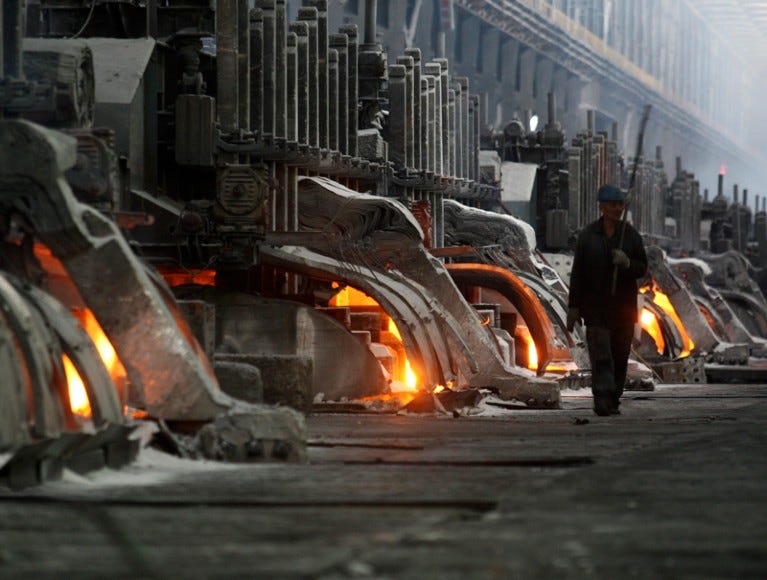
The first was aluminium. Iranian strikes on Gulf smelting infrastructure removed approximately three million tonnes of annual capacity from Emirates Global Aluminium and Aluminium Bahrain, both now operating under partial force majeure with restart timelines of six to twelve months.[1] The second was helium. A significant share of the world’s helium supply exits Qatar’s Ras Laffan complex on the same liquefied natural gas tankers that transit Hormuz — the tankers that are now variously diverted, delayed, or waiting.[2] The third was semiconductor manufacturing equipment. A bill introduced in Washington the same week, the Multilateral Alignment of Technology Controls on Hardware Act, placed allied vendors including ASML on a 150-day clock to match US export controls or lose access to US intellectual property and components.[3] The fourth was the alliance itself. France and the United Kingdom announced a joint naval mission to the Strait of Hormuz operating outside the American blockade framework, the first operational admission that European strategic interests can no longer be safely delegated to Washington.[4]
Four chokepoints. One fortnight. Board papers still calling it an oil shock.
What failed at the metal floor
Aluminium is the first chokepoint because aluminium is the first input. Data centre chassis, server rack framing, cable trays, electric vehicle battery housings, and the structural components of satellite and aerospace platforms all rely on specialised grades from Gulf smelters. The loss of three million tonnes of annual capacity from Emirates Global Aluminium and Aluminium Bahrain transmits into European automotive, aerospace, and construction sectors within a single inventory cycle.[1] Procurement directors who treated this material as commoditised will discover, over the next quarter, that it was a single-point dependency.
Helium is the chokepoint that almost nobody outside semiconductor and cryogenic engineering is currently watching. Qatar is the world’s second-largest helium producer — approximately 25 per cent of global supply, exiting via Ras Laffan on the same tanker fleet now caught in the Hormuz disruption.[2] Helium is not substitutable for semiconductor fabrication, magnetic resonance imaging, or the cryogenic cooling of superconducting infrastructure. A protracted closure does not simply raise prices; it triggers allocation rationing. Strategic reserves at fabs in Taiwan, South Korea, and the Netherlands are measured in weeks, not months.
The equipment chokehold
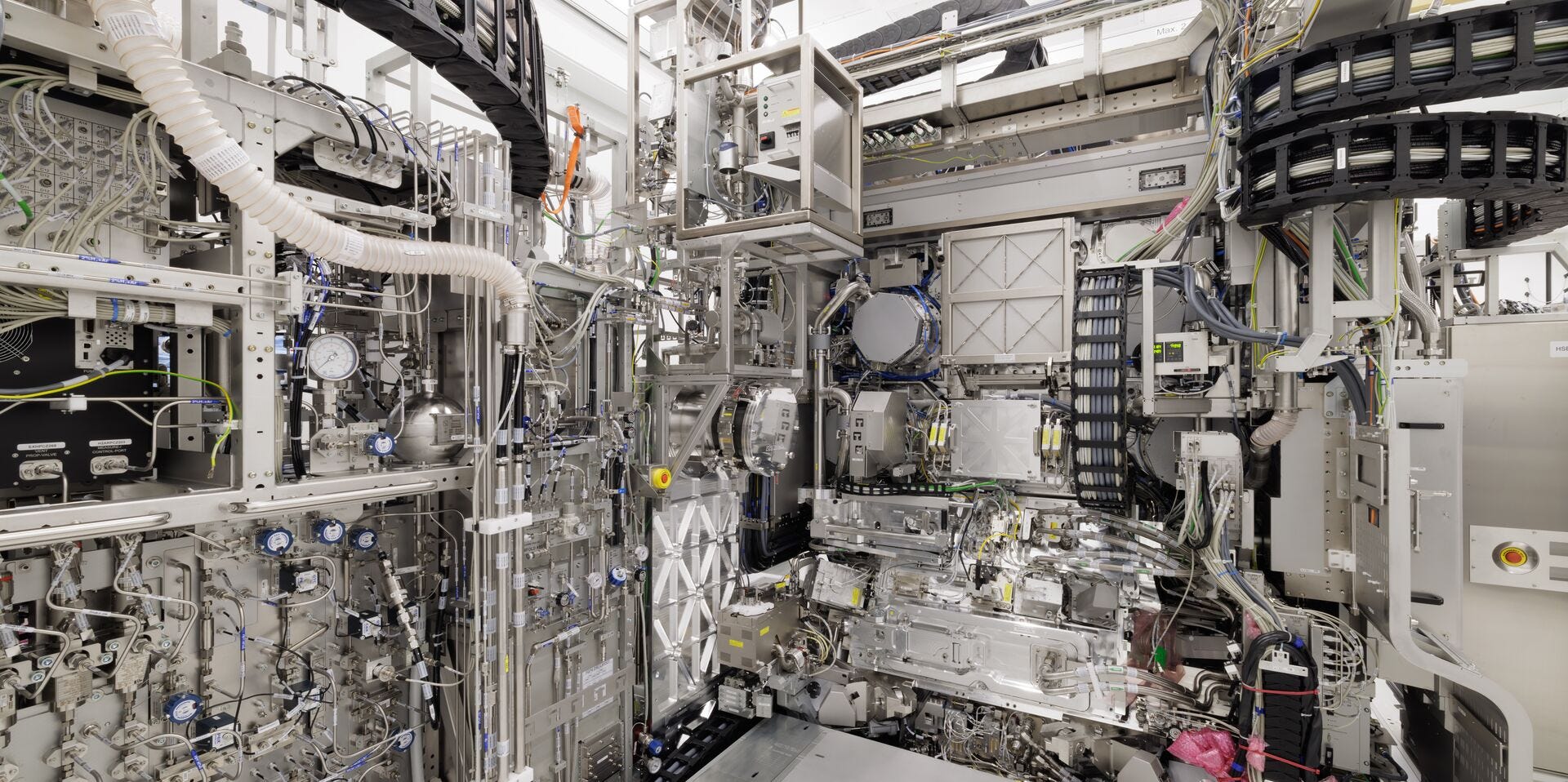
The Multilateral Alignment of Technology Controls on Hardware Act is a Foreign Direct Product Rule delivered as legislation. It gives allied vendors 150 days to match the US export control posture on semiconductor manufacturing equipment shipped to China, or lose access to US components, software, and intellectual property.[^3] ASML, the Dutch monopolist in lithography, derives approximately 50 per cent of its Deep Ultraviolet sales from China.[^5] The MATCH Act is not a trade dispute. It is the termination of the allied exemption that has structured European technology policy since the 1990s.
The administrative bottleneck running parallel to the legislation is the deeper signal. The US Bureau of Industry and Security, hollowed out by a 19 per cent reduction in headcount, now processes export licences for trusted allies — the United Kingdom, Japan, Canada — at an average of 76 days, double the 2023 baseline.[6] Multi-billion dollar backlogs in the deployment of artificial intelligence infrastructure are accumulating in countries Washington formally describes as partners. The semiconductor industry has formally warned that this undermines Western competitiveness; the political response so far has been silence.
When the alliance itself becomes a chokepoint
The Franco-British maritime mission is the piece of news that looked smallest and mattered most. By announcing a joint naval deployment to the Strait of Hormuz operating outside the American blockade framework, Paris and London formalised what had until then been a private frustration: European strategic interests can no longer be safely delegated to Washington.[4] The mission is described as “strictly defensive” — diplomatic language for we are not doing what the Americans are doing. The communiqué is the document historians will reach for when they date the inversion of the post-war bargain.
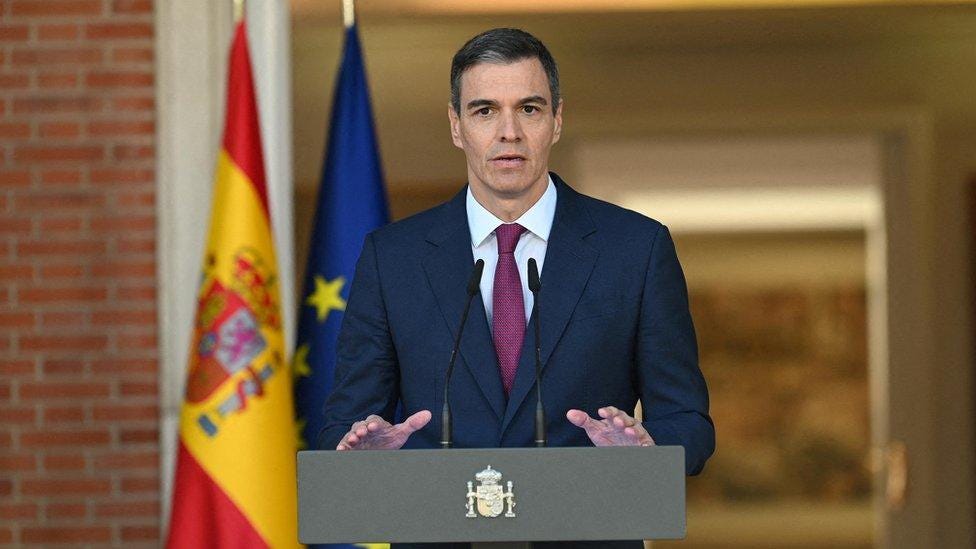
Spain’s concurrent state visit to Beijing — Prime Minister Pedro Sánchez meeting President Xi Jinping to secure Chinese foreign direct investment in Spanish renewable energy, biopharmaceuticals, and engineering firms — confirms that the fragmentation runs in multiple directions at once.[7] The European Union’s stated “de-risking” strategy is contradicted from inside the bloc the same week it is contradicted from outside. The €359.8 billion EU trade deficit with China published by Eurostat on 10 April is the empirical evidence that de-risking has not, in fact, been happening.[8]
The inversion Helen Thompson predicted
The historian Helen Thompson argued in Disorder: Hard Times in the 21st Century that the post-war Atlantic settlement was always a contingent arrangement of energy, security, and finance — not a permanent moral architecture, and not stable indefinitely.[9] What Thompson described in long historical register, this fortnight delivered in operational form. The bargain that afforded eighty years of European prosperity has not strained; it has inverted. The arrangement that once underwrote European security now actively imposes the principal structural risk to European prosperity, because the unilateral instruments Washington is willing to deploy — naval blockades, extraterritorial export controls, tariff revisions targeting allied vendors — operate on Europe with the same force they operate on adversaries.
The implication for any UK or European business is not that the United States has become hostile. It is that the United States has become unpredictable in ways that make American technology, American security guarantees, and American capital markets newly risky as default assumptions. A treasury function that holds a majority of its corporate cash in dollar instruments, a procurement function that defaults to American hyperscalers, an operations function that assumes American-flagged vessels will move its goods — each of these is now a position with a beta to American political volatility, which is currently the highest beta in the global system.
What your board paper should now say
Adam Tooze has argued, persuasively, that the polycrisis is structural rather than episodic — that the convergent shocks of the past five years are not a sequence of unrelated events but the surface expression of a single underlying re-ordering.[10] If that frame is correct, and the evidence of this fortnight is that it is, then the quarterly enterprise risk paper that treats geopolitics as a “watch item” under “external environment” is no longer a serious document.
Three lines that should be rewritten in the next paper to the Audit and Risk Committee:
The first line is the vendor concentration matrix. Any matrix that aggregates “cloud” or “AI infrastructure” as a single category, without breaking out the proportion held with US hyperscalers versus UK or EU sovereign providers, is now under-specified. The MATCH Act timeline is 150 days. The board needs to know, before that clock expires, which workloads are exposed to a unilateral American export control on the equipment used to build the infrastructure those workloads run on.
The second line is the supply chain map. Any map that treats freight insurance, lead times, and chokepoint exposure as logistics rather than as strategic risk is mis-categorising the data. The 7 to 15 days now added to Asia–Europe ocean transit via the Cape of Good Hope, the 10 per cent effective capacity reduction across global ocean networks, and the 30 to 40 per cent increase in greenhouse gas emissions on diverted routes are not operational frictions.[11] They are the new permanent baseline for any inventory model.
The third line is the political risk register. Any register that lists “geopolitical instability” as a single item, without naming the specific transatlantic instruments that now operate against allied interests, is performing risk theatre. The instruments are named: the MATCH Act, the Section 232 tariff revisions, the BIS licence delays, the Strait of Hormuz blockade. They are dated. They are quantifiable.
What happens in the next eighteen months
Noah Smith has argued that the West’s stance towards China is “derisking, not decoupling” — a graduated reduction of dependency rather than a clean break.[12] That framing was accurate for the first half of the decade. It is now, in the spring of 2026, behind the curve. We are past derisking. The next eighteen months are about procurement-driven re-sovereigntisation, and the evidence will accumulate in three places.
The first place is public-sector contract awards. UK Government Digital Service procurement, the Crown Commercial Service framework refreshes, the EU Chips Act Pillar II disbursements, and the German Bundesnetzagentur tenders for sovereign data infrastructure will publish award data quarterly. Watch the share going to UK and EU domiciled providers. The trend is already visible; the question is the slope.
The second place is capital re-allocation. Institutional investors and pension funds with ESG and political risk mandates will rotate from US tech megacaps into UK and European technology equities at the rate the procurement signal becomes legible. London is already the deeper liquidity venue for European listings; the question is whether sovereign procurement creates enough domestic earnings growth to make London the primary listing venue rather than the secondary one.
The third place is the regulatory perimeter. Labour has publicly ruled out single market re-entry during this parliament. That position will hold formally and shift operationally. Expect de facto alignment — on data, chemicals, product standards, and critical infrastructure procurement — to advance materially within 18 months, regardless of de jure status. By October 2027, the operational distinction between UK and EU regulatory regimes for sovereign technology procurement will be substantially smaller than it is today.
The bottom line
The board paper being written this week, in the commuter-belt office of a senior risk director somewhere between Manchester and London, has a choice. It can describe the events of the last fortnight as an oil shock plus three unrelated technology stories. Or it can describe them as a single inversion — the moment the post-war bargain stopped underwriting prosperity and began pricing it. The first description is comfortable and wrong. The second is uncomfortable and accurate.
The Control Layer exists to translate a Strait of Hormuz headline into a page-three line item in your Audit and Risk Committee paper, in a voice a board will quote — because nobody else on Substack is doing that translation, and the quarter that has begun is the one in which boards either commission that translation or discover, in the next quarter’s loss provision, that they should have.
Subscribe to receive Part 2 — The metal floor: aluminium, helium, and the hidden inputs to the sovereign technology stack — and the rest of the Four Chokepoints series.
References
[1]: Reuters. *“Gulf aluminium output crippled as Iranian strikes hit EGA and Alba facilities.”* 11 April 2026.
[2]: U.S. Geological Survey. *“Mineral Commodity Summaries 2026 — Helium.”* January 2026.
Linde plc. *“Annual Report 2025 — Helium Supply Chain Disclosures.”*
[3]: U.S. House of Representatives. *Multilateral Alignment of Technology Controls on Hardware Act*, H.R. 8170, 119th Congress (2026).
[4]: HM Government and Government of the French Republic, joint communiqué. *“Franco-British Defensive Maritime Mission to the Persian Gulf.”* 10 April 2026.
[5]: ASML Holding N.V. *“Annual Report 2025 — Geographic Revenue Disclosure.”*
[6]: U.S. Bureau of Industry and Security. *“Export Licensing Performance Report Q1 2026.”*
[7]: Government of Spain, Office of the Prime Minister. *“State Visit to the People’s Republic of China, 13–15 April 2026.”*
[8]: Eurostat. *“EU trade in goods with China — 2025 annual data.”* Released 10 April 2026.
[9]: Helen Thompson. *Disorder: Hard Times in the 21st Century*. Oxford University Press, 2022.
[10]: Adam Tooze. *Chartbook* (Substack). See in particular Chartbook #321 on the structural polycrisis framework.
[11]: Drewry Shipping Consultants. *“Container Shipping Outlook April 2026.”* Cited in *Lloyd’s List*, 11 April 2026.
[12]: Noah Smith. *Noahpinion* (Substack). *“Derisking, not decoupling: the West’s actual China strategy.”*
Author
Amer Altaf is Founder and CEO of Arkava, a UK and European sovereign AI agentic automation business, and Managing Editor of The Control Layer, the publication where he tracks the convergence of cyber security, technology sovereignty, and geopolitics. A techUK member, he contributes to industry engagement on UK technology sovereignty policy. His January 2026 analysis of Airbus’s migration off Google and Microsoft argued European cloud sovereignty had moved from policy aspiration to active corporate posture — six months before the Hormuz blockade made the argument unavoidable. He is currently writing on cloud security for Oxford University Press’s Expert Essentials series.