
Europe's Sovereignty Test: Can the Continent Finally See From Space Without American Help?

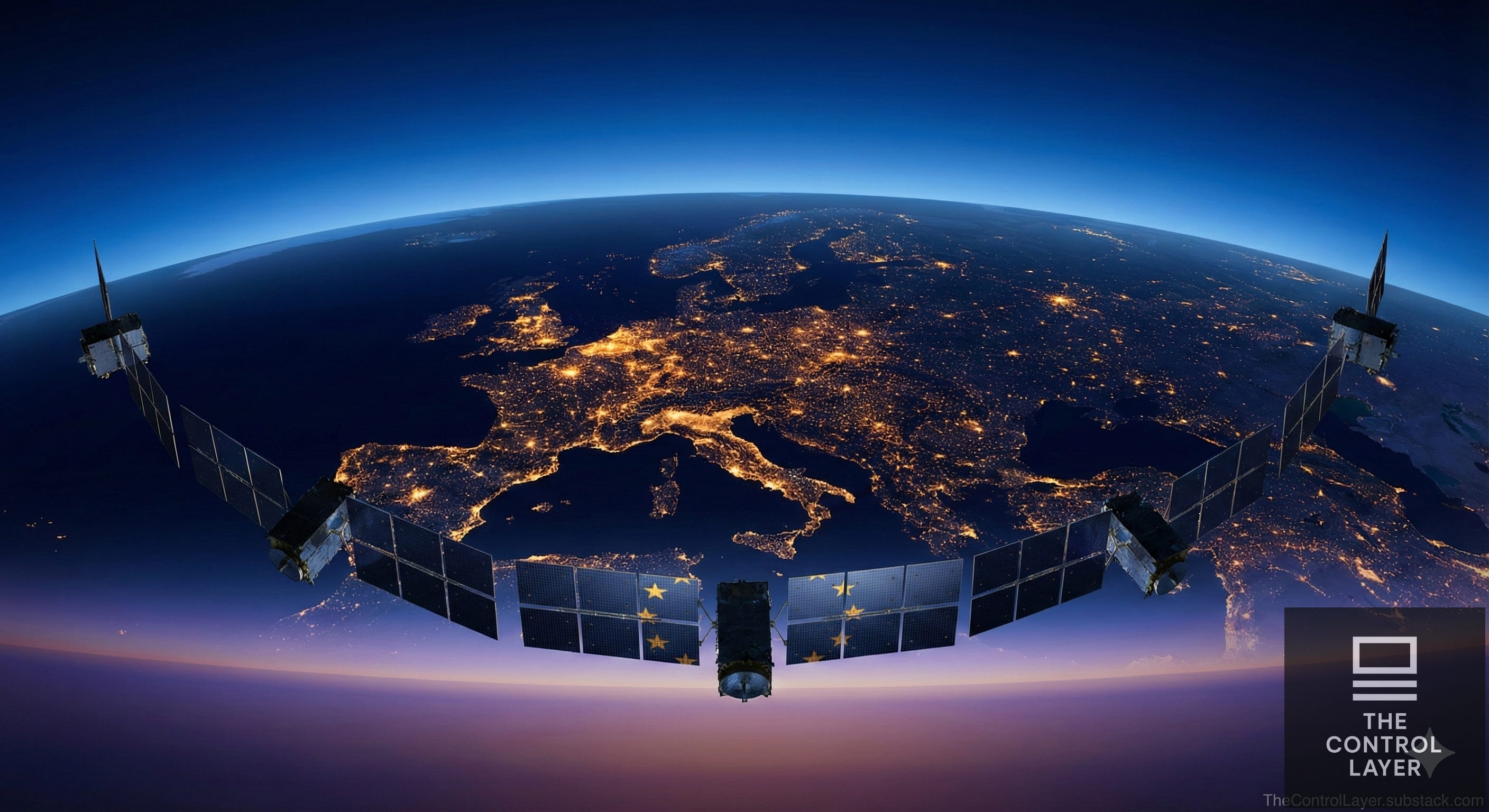
Why it matters: Europe’s dependence on American satellites is not a technical inconvenience. It is a strategic vulnerability that shapes foreign policy, constrains military options, and undermines the credibility of European defence. The Kongsberg-Helsing satellite alliance is the most concrete test yet of whether European sovereignty can move from aspiration to reality.
A Dependency Laid Bare
The phone call that changed European defence thinking did not come from a general or a minister. It came in March 2025, when the Trump administration informed Ukraine that intelligence sharing would be paused.[7][8][9]
The immediate impact fell on Kyiv. But the deeper shock rippled through European capitals. For decades, NATO allies had operated under an implicit assumption: American space-based intelligence would always be available. That assumption proved fragile.
Europe, it turned out, cannot see its own continent from orbit without American assistance. Surveillance satellites, targeting data, real-time situational awareness: all of it flows through systems that Washington controls.[6] When that flow stopped, European leaders confronted a question they had long deferred: what does sovereignty mean if you cannot observe your own territory?
“Sovereign monitoring, intelligence, and targeting are fundamental to credible deterrence,” said Eirik Lie, President of Kongsberg Defence & Aerospace, announcing a new partnership in December 2025. “Europe needs full control over these capabilities.”[3]
That partnership, a joint venture between Norway’s Kongsberg and Germany’s Helsing to deploy 75 to 100 satellites by 2029, represents the most ambitious attempt yet to answer that question.[1][2][3]
The Sovereignty Gap
European strategic autonomy has been a policy goal for years. The phrase appears in countless summit communiqués, ministerial speeches, and EU strategy documents. Yet the gap between rhetoric and capability remains vast.
Consider space. The European Space Agency has achieved remarkable scientific success, from Rosetta’s comet landing to the James Webb Space Telescope contributions. But military and intelligence applications have lagged. Europe operates no sovereign constellation for reconnaissance or targeting. When European forces deploy, they rely on American eyes in the sky.
This dependency creates three distinct problems.
First, it constrains independent action. European nations cannot conduct military operations, even within their own neighbourhood, without intelligence that another power controls. When interests diverge, as they did over Ukraine policy in early 2025, that dependency becomes a vulnerability.
Second, it undermines deterrence credibility. A defence posture that depends on borrowed capabilities sends a signal to adversaries: European resolve can be undermined by pressuring Washington. Strategic autonomy requires more than political will. It requires infrastructure.
Third, it shapes industrial capacity. Defence technology develops where investment flows. Decades of reliance on American systems have left European space defence industries underdeveloped compared to their potential. The Kongsberg-Helsing partnership aims to reverse this dynamic.
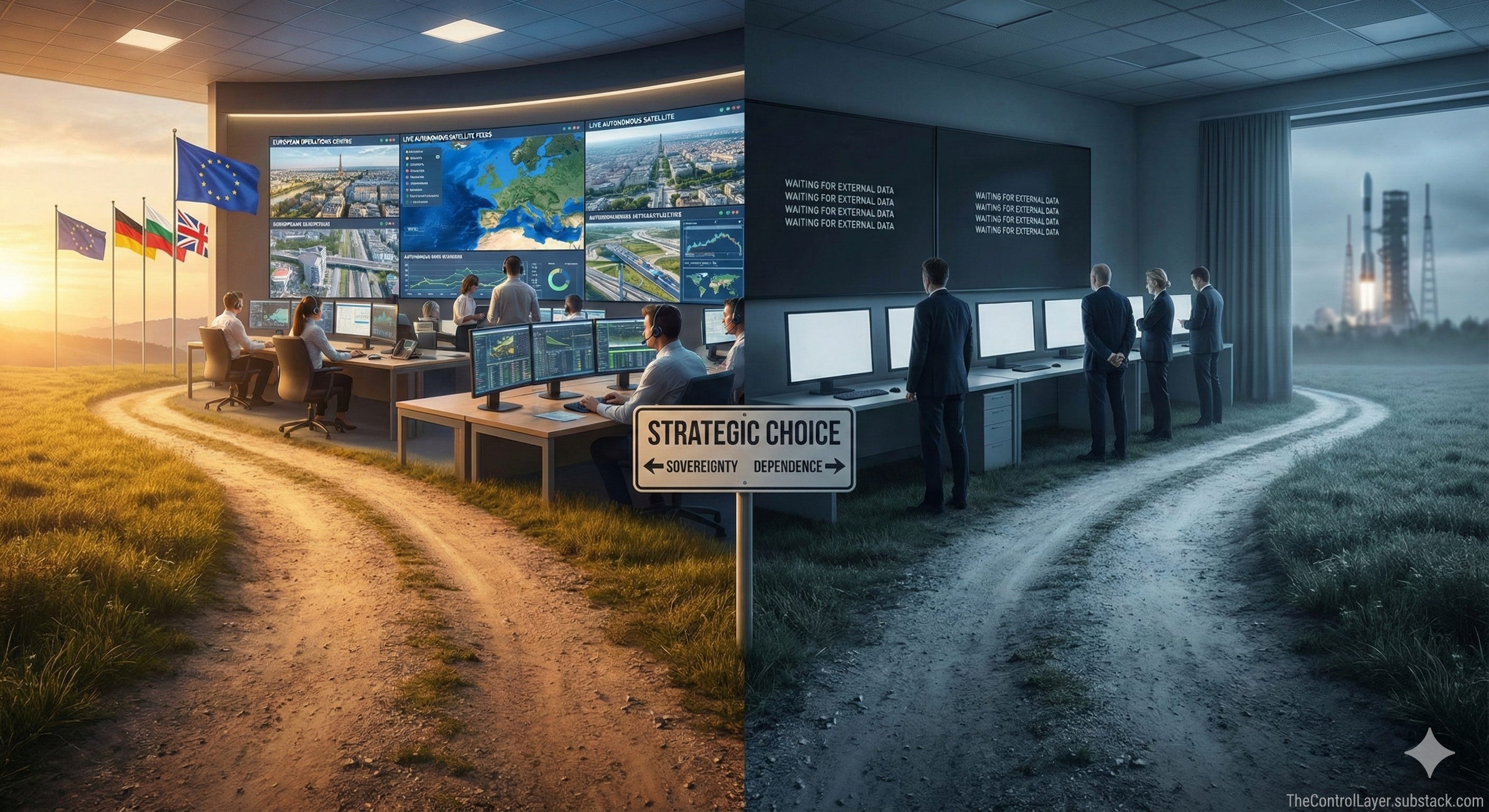
The Institutional Response
The March 2025 intelligence pause accelerated institutional action that had been building for years.
In October 2025, the European Council published its “Preserving Peace: Defence Readiness Roadmap 2030,” calling for “accelerated joint development of space assets and services that serve security and defence purposes.”[24] The document marked a shift from aspiration to planning, with specific timelines and capability targets.
The European Commission’s proposed EU Space Act, published in June 2025, provides the regulatory framework. The Act aims to create a harmonised single market for space activities, establishing common safety, sustainability, and cybersecurity standards across member states.[25] For the first time, European space activities would operate under unified governance rather than fragmented national approaches.
Germany has backed these frameworks with substantial investment. In September 2025, Defence Minister Boris Pistorius announced €35 billion for space defence through 2030, targeting five priorities: system hardening, space situational awareness, redundant satellite networks, diverse launch capabilities, and a dedicated military satellite operations centre.[10][11][12]
These institutional moves create the conditions for private sector investment. The Kongsberg-Helsing partnership did not emerge in a vacuum. It emerged because European governments signalled, through policy and funding, that sovereign space capabilities had become a strategic priority.
The Partnership Model
The Kongsberg-Helsing alliance exemplifies a new approach to European defence collaboration: multinational, public-private, and capability-focused rather than politically driven.
Kongsberg brings satellite platform expertise. The Norwegian company launched its N3X maritime surveillance constellation in June 2025, demonstrating manufacturing and operational capability.[13][14] Helsing contributes artificial intelligence software that can fuse multiple sensor inputs simultaneously: synthetic aperture radar, electro-optical imagery, and radio frequency signals.[3][1]
The consortium extends further. German sensor manufacturer Hensoldt will provide radar and electro-optical systems.[2][15] Kongsberg Satellite Services (KSAT) will manage global ground infrastructure.[3] German startup Isar Aerospace will launch from Andøya Space in Norway, continental Europe’s first operational spaceport, where it holds exclusive access through 2041.[4][5]
This structure deliberately distributes capability across nations. Norwegian platforms, German AI and sensors, pan-European ground networks, Nordic launch facilities. No single country controls the entire system. No single company holds irreplaceable expertise. The architecture itself embodies sovereignty: European capability, European control, European resilience.
Both lead partners have deployed technologies in Ukraine since 2022.[3][1] Helsing’s AI algorithms already operate in orbit for existing missions.[1] This is not theoretical capability. It has been tested under combat conditions, providing validation that PowerPoint strategies cannot match.

Competition and Complementarity
The Kongsberg-Helsing partnership enters a competitive European space intelligence market, which itself reflects the sovereignty imperative.
Finland’s ICEYE operates what it describes as the world’s largest synthetic aperture radar constellation. Over the past year, the company has secured sovereign satellite contracts with Poland, Portugal, the Netherlands, Greece, and Finland.[19][20] ICEYE raised €200 million in December 2025, reaching a €2.4 billion valuation, and plans to produce one satellite per week in 2026.[19][20][21]
The European Union is advancing IRIS², a communications satellite constellation comprising 264 satellites in low Earth orbit and 18 in medium Earth orbit. IRIS² focuses on secure communications rather than surveillance, with government services expected by 2030 and full operations in the early 2030s.[22][23]
These initiatives are complementary. IRIS² addresses communications sovereignty. ICEYE and the Kongsberg-Helsing constellation address intelligence sovereignty. Together with national programmes, they represent a multi-layered approach to reducing European dependence on non-European systems.
The competitive dynamic also serves sovereignty. Multiple European providers create redundancy, drive innovation, and prevent the emergence of single points of failure. If one constellation experiences problems, others can provide backup. If one company faces supply chain disruptions, alternatives exist. Sovereignty requires not just capability, but resilience.
Analysis: What Sovereignty Actually Requires
In my view, three factors will determine whether European space sovereignty succeeds or remains rhetorical.
Keep reading with a 7-day free trial
Subscribe to The Control Layer to keep reading this post and get 7 days of free access to the full post archives.