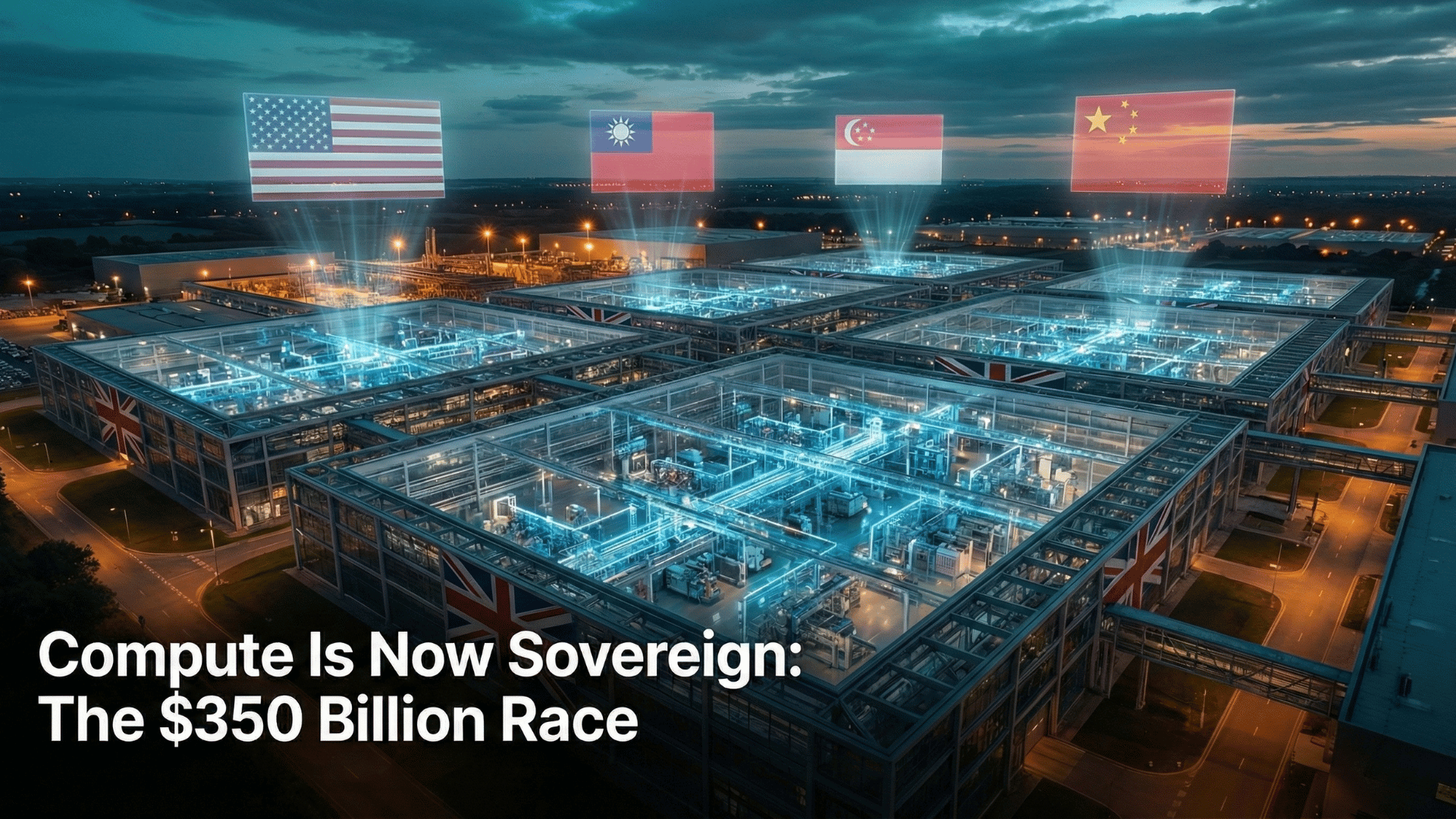
Compute Is Now Sovereign
The $350 Billion Race to Control AI's Substrate
Why it matters: This week, the US and Taiwan announced a $250 billion semiconductor investment pact. Singapore committed S$1 billion to AI research through 2030. And Nvidia's planned $100 billion investment in OpenAI stalled amid internal doubts. These are not commercial transactions. They are acts of industrial policy that will determine which nations control the substrate of artificial intelligence—and which become dependent on others.
Join The Control Layer for weekly perspectives on AI, cybersecurity, and building technology that serves human purpose.
The week that made compute geopolitical
Three announcements in seven days revealed just how explicitly governments now treat AI compute as strategic infrastructure.
On 19 January, the US and Taiwan formalised a $250 billion semiconductor and AI investment pact designed to accelerate the movement of frontier chip production to American soil [1]. The agreement commits Taiwanese semiconductor firms—including TSMC, the world’s most advanced chipmaker—to expand US manufacturing footprint. This is supply-chain decoupling dressed in commercial language.
On 24 January, Singapore’s Ministry of Trade and Industry announced S$1 billion (approximately $779 million USD) in public investment for AI research through 2030, with explicit emphasis on “responsible AI development, compute infrastructure, and industrial deployment” [2]. For a city-state of 5.5 million people, this represents extraordinary per-capita commitment to compute sovereignty.
On 30 January, Reuters reported that Nvidia’s planned $100 billion investment in OpenAI—critical to OpenAI’s training and inference scaling ambitions—had stalled amid internal resistance over deal structure and capital efficiency [3]. Even the firms betting billions on AI are questioning whether the economics hold.
The message is unmistakable: compute is no longer a commodity to be purchased on the open market. It is strategic infrastructure to be secured, subsidised, and protected.
Why compute determines AI power
The AI systems making headlines—GPT-5.2, Claude Opus 4.5, DeepSeek, Qwen—are fundamentally expressions of compute. Training frontier models requires tens of thousands of specialised processors running for months. Inference at scale requires data centres consuming as much electricity as small cities.
Control compute, and you control who can build frontier AI systems. Control the supply chain that produces compute, and you control the future of the technology.
This explains why the US-Taiwan pact matters beyond the headline figure. TSMC manufactures over 90% of the world’s most advanced semiconductors. Its facilities in Taiwan sit 180 kilometres from mainland China. The $250 billion commitment is insurance against geopolitical disruption—ensuring that even if Taiwan’s facilities became inaccessible, the US would retain domestic manufacturing capability for the chips that power AI [1].
Singapore’s investment follows different logic but reaches the same conclusion. As a trade-dependent nation with no natural resources, Singapore has historically survived by positioning itself at critical nodes of global commerce. The S$1 billion AI commitment positions the city-state as a neutral compute hub for Asian enterprises wary of both US and Chinese infrastructure dependencies [2].
The UK’s compute position
Where does this leave Britain?
The UK’s chief sovereign compute asset is Isambard-AI, hosted at the National Compositing Centre in Bristol. At 21 exaFLOPs of AI compute capacity, 217 petaFLOPs of conventional processing, and 25 petabytes of storage, it represents genuine frontier capability [4]. When it came online, it was the most powerful AI supercomputer in Europe.
But capability and strategy are different things. The UK has not matched the US or Singapore with comparable public investment commitments. The anticipated AI Bill did not materialise in 2025 and remains unlikely in 2026 [5]. The government continues its sector-led regulatory approach while other nations are making explicit industrial policy bets.
This creates asymmetric risk. UK organisations building AI capabilities on American cloud infrastructure—AWS, Azure, Google Cloud—remain subject to the US CLOUD Act, which permits US authorities to compel disclosure of data stored by US-headquartered providers regardless of where that data physically resides [6]. For defence contractors, regulated financial services, and critical national infrastructure operators, this is not a theoretical concern.
The choice is not between British isolationism and global integration. It is between strategic autonomy and structural dependency. Other nations are choosing autonomy. The UK’s position remains ambiguous.
Analysis: What strategic compute investment looks like
The US-Taiwan pact and Singapore commitment share three characteristics worth noting.
First, they are explicit industrial policy. Neither announcement pretended to be purely commercial. Both governments stated openly that AI compute infrastructure is a national strategic priority requiring public investment, regulatory alignment, and long-term commitment. This clarity enables coordinated action across government, industry, and research institutions.
Second, they address the full stack. The US-Taiwan pact covers chip manufacturing, not just chip purchasing. Singapore’s commitment spans research, infrastructure, and deployment. Both recognise that compute sovereignty requires domestic capability across the value chain—not just the ability to buy finished products from foreign suppliers.
Third, they create optionality. The US is not abandoning Taiwanese manufacturing; it is creating alternatives. Singapore is not rejecting US or Chinese cloud providers; it is building infrastructure that reduces dependency on either. Strategic compute investment is about expanding choices, not limiting them.
The UK’s Isambard-AI represents genuine capability. But a single supercomputer, however powerful, is not a compute strategy. A strategy would address: domestic semiconductor design and manufacturing capability; sovereign cloud infrastructure for regulated sectors; research funding tied to compute access; and clear policy on foreign data access risks.
In my view, the window for the UK to articulate such a strategy is narrowing. The US, China, Singapore, and the EU are making their positions clear. Ambiguity is itself a strategic choice—and not necessarily a wise one.
The private sector is already responding
While governments debate, enterprises are making their own calculations.
Forrester’s January 2026 survey found that 84% of UK IT leaders express concern about geopolitical data access risks [7]. This is not abstract anxiety. It reflects concrete questions: Can we use US cloud providers for sensitive workloads? What happens if US-China tensions disrupt semiconductor supply? How do we maintain operational continuity if our compute infrastructure becomes a geopolitical liability?
The enterprise response is fragmentation. Organisations are hedging—running some workloads on US hyperscalers for cost and capability, while building parallel infrastructure on European or UK-sovereign alternatives for sensitive operations. This is expensive, complex, and inefficient. But it is rational given policy uncertainty.
For mid-market organisations—typically £50M to £500M in revenue—this hedging is particularly burdensome. Large enterprises can afford multi-cloud strategies with dedicated sovereignty compliance teams. Mid-market firms face the same regulatory and geopolitical risks with a fraction of the resources to manage them.
Risks and constraints
The sovereignty argument carries important limitations.
First, complete compute independence is neither achievable nor desirable. No nation—not even the US or China—can produce every component of the AI stack domestically. The goal is strategic autonomy, not economic self-sufficiency. This means reducing critical dependencies and creating alternatives, not eliminating all foreign supply chains.
Second, sovereignty comes with costs. Domestic infrastructure typically costs more than global alternatives optimised for scale. Organisations choosing sovereign compute may sacrifice capability or efficiency. The question is whether the risk reduction justifies the premium—and that calculation differs by sector, data sensitivity, and threat model.
Third, the geopolitical situation remains fluid. US-UK intelligence cooperation is deep. The CLOUD Act’s practical impact on UK organisations depends heavily on enforcement patterns that could change with administrations. Building strategy around today’s geopolitical alignment may prove shortsighted if that alignment shifts.
Fourth, the UK has genuine strengths. British AI research remains world-class. DeepMind (Alphabet-owned but London-headquartered) and the Alan Turing Institute represent significant intellectual capital. The question is whether these strengths translate into industrial capability or remain vulnerable to acquisition and relocation.
What to do next
For boards and executives: Audit your compute dependencies. Map which workloads run on which infrastructure, with what data residency implications. Understand your exposure to the CLOUD Act and equivalent foreign data access provisions. This is not a technology question—it is a board-level risk question.
For technical leaders: Evaluate sovereign alternatives for sensitive workloads. UK-sovereign cloud providers exist, though with capability trade-offs. Hybrid architectures—US hyperscalers for non-sensitive compute, sovereign infrastructure for regulated data—may represent the practical middle ground while policy clarity emerges.
For mid-market organisations: Engage with industry associations and government consultations on AI and compute strategy. The UK’s approach remains in flux. Organisations that articulate their needs clearly have an opportunity to shape policy. Waiting for clarity may mean accepting terms set by others.
For policy watchers: Monitor DSIT announcements on compute strategy and potential Isambard-AI Phase 2 funding. The government’s response to the US-Taiwan pact and Singapore commitment will signal whether the UK views compute as strategic infrastructure or simply another market to regulate.
Disclaimer: This article represents analysis based on publicly available information as of January 2026. It does not constitute legal, financial, or professional advice.
If your organisation needs support navigating sovereign AI deployment and compliance frameworks, Arkava helps mid-market enterprises build AI capabilities on UK-controlled infrastructure.
References
[1] US Department of State & Taiwan Economic and Trade Office. “US–Taiwan Semiconductor and AI Investment Pact.” 19 January 2026. $250 billion direct investment for compute manufacturing.
[2] Singapore Ministry of Trade & Industry. “National AI Research Initiative (2026–2030).” 24 January 2026. S$1 billion commitment (≈$779m USD).
[3] Wall Street Journal (via Reuters). “Nvidia’s Plan to Invest Up to $100 Billion in OpenAI Has Stalled.” 31 January 2026. https://www.reuters.com/business/nvidias-plan-invest-up-100-billion-openai-has-stalled-wsj-reports-2026-01-31/
[4] The Control Layer (Arkava). “Isambard-AI: The UK’s Leap to the Cutting-Edge.” 23 July 2025.
— 21 exaFLOPs AI compute; 217 petaFLOPs conventional; 25 petabytes storage.
[5] UK DSIT & Osborne Clarke. “AI Regulation: UK Regulatory Outlook.” January 2026. https://www.osborneclarke.com/insights/regulatory-outlook-january-2026-artificial-intelligence
[6] US CLOUD Act (Clarifying Lawful Overseas Use of Data Act). 2018. Permits US authorities to compel disclosure from US-headquartered providers regardless of data location.
[7] Forrester Research. “Enterprise AI Adoption: Balancing Innovation and ROI in 2026.” 26 January 2026. https://bizzdesign.com/blog/enterprise-ai-adoption-balancing-innovation-and-roi-2026


