Britain’s Compute Bet: Inside the 10-Point Plan to Power the AI Economy
“Compute isn’t just infrastructure; it’s economic policy in silicon.”
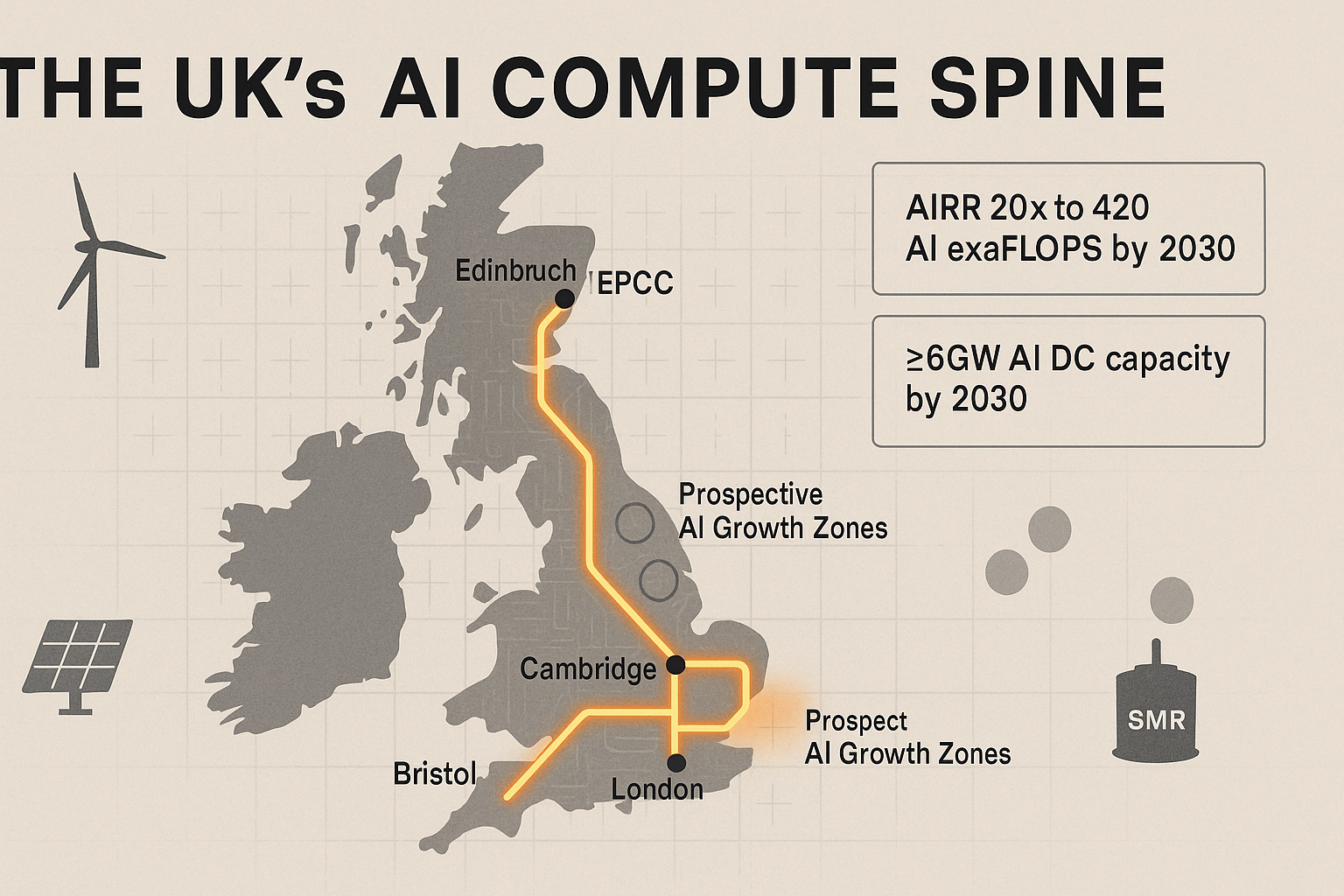
The UK government’s new Compute Roadmap sets out a long-term plan to turn compute from a scattered set of assets into strategic infrastructure. It pledges up to £2 billion by 2030, a 20× expansion of the public AI Research Resource (AIRR) to 420 AI exaFLOPS, a new national supercomputer at EPCC (online early 2027), and AI Growth Zones (AIGZs) that target ≥6 GW of AI-capable datacentre capacity by 2030. Here’s what’s in the plan, how it compares to the US, EU and China—and what UK businesses should do now.
Why compute is now strategic infrastructure
The past 24 months have made one thing clear: access to large-scale compute now shapes national competitiveness, from frontier AI research to productivity growth across every sector. Britain’s Compute Roadmap states the case plainly and backs it with capital: up to £2 billion between now and 2030 to build a modern public compute ecosystem that complements private investment.
Two anchors define the ambition. First, the public AI Research Resource (AIRR) is set to grow 20×—from 21 AI exaFLOPS in 2025 to 420 by 2030 (AI exaFLOPS denote the effective floating-point operations per second typical for AI workloads; one exaFLOP is 10^18 calculations per second). Second, the UK will stand up AI Growth Zones targeting ≥6 GW of AI-capable datacentre capacity by 2030, with individual sites designed to reach ≥500 MW and at least one surpassing 1 GW.
The Roadmap frames compute as a sovereign capability: public infrastructure for research, safety evaluation and national priorities, plus market-shaping moves—procurement, testbeds and “pull-through” to commercial scale—that aim to grow domestic suppliers across chips, systems and software. The plan also promises a better user journey via AIRRPORT (a single front door), National Supercomputing Centres (NSCs), Community Centres of Excellence (CCEs), and a design principle of interoperability and portability so workloads can move across on-prem, cloud and hybrid environments.
Most importantly, the government sets a cadence: 2025 “Lay the foundations”, 2027 “Deploy, scale & evolve” (including ~£750 m of AIRR expansions and the EPCC system going live), and 2030+ “Refresh, reinvest”—explicitly recognising how quickly architectures, energy systems and use-cases are changing.
Call-out: “By 2030, Britain wants ≥6 GW of AI-capable capacity—and at least one >1 GW site.
What’s actually in the plan
Step 1 — Build a modern public compute ecosystem
Funding envelope: Up to £2 billion to deliver a diverse, joined-up, user-centred ecosystem—combining purpose-built AI supercomputers with cloud-based compute for flexibility. Within that, >£1 billion is earmarked to expand the AIRR 20× (21 → 420 AI exaFLOPS) by 2030.
What’s an “AI exaFLOP”? It’s one quintillion floating‑point operations per second — enough compute to outpace a billion people working through maths problems for thousands of years, in a single lightning‑fast second.
User experience & access: AIRRPORT becomes the single front door to submit jobs, move workloads, access tools and manage data across AIRR systems. Interoperability and portability are called out as design principles so users can shift workloads between on-prem, cloud and hybrid.
National Supercomputing Centres (NSCs): A federated NSC network will anchor the most powerful public systems, curate datasets (linked with NDL/HDRS), build software assets, and deliver a skills pipeline. EPCC in Edinburgh is the first NSC and will host the new national supercomputer (see below). CCEs will provide domain-specific support; a Grand Software Challenge and skills programme launch in 2026.
Step 2 — Put compute to work for outcomes
Allocation reform: The government will refresh AIRR allocations to prioritise mission-driven research and high-impact innovation across public and private users. This reorients from “fill the machines” to “fund the breakthroughs” with structured calls, faster processes and crisis-response capacity.
Dedicated tracks for AISI & Sovereign AI: The AI Security Institute (AISI) and the Sovereign AI Unit get reserved capacity and will allocate it to evaluation, red-teaming, frontier risk analysis and sovereign R&D projects respectively. Compute is explicitly established as a priority area for Sovereign AI, creating a “pull-through” from living benchmarking and NSC testbeds into deployments.
Step 3 — Build AI infrastructure via AIGZs
Demand signal: The UK forecasts ≥6 GW of AI-capable datacentre capacity by 2030—around 3× today’s overall UK DC capacity—with core sites ≥500 MW and ≥1 site >1 GW. First AIGZ sites are slated to commence by year-end, including in Scotland and Wales.
Energy model: Government will explore new delivery models—behind-the-meter low-carbon power, microgrids, storage and flexible demand—and options to incorporate advanced nuclear (e.g., SMR) at least at a demonstrator site.
Step 4 — Sovereign capability & industrial pull-through
Compute “Bridge”: A diagrammatic R&D → Testbeds (NSCs & Living Benchmarks) → Scale in AIGZs pathway is formalised to pull UK-developed chips, systems and software into at-scale deployments. Procurement criteria will evolve so novel architectures aren’t excluded by legacy benchmarks.
International partnerships: The UK will leverage and deepen participation in EuroHPC and other alliances to broaden access to architectures not yet available domestically.
Key milestones & assets
EPCC national supercomputer: Up to £750 million, online early 2027, with projected capacity that would put it in the top-5 supercomputers of today; designed for both simulation and AI workloads; replaces ARCHER2.
2025–2027 cadence: 2025 focuses on laying foundations (AIGZ announcements; EPCC designated first NSC; procurement frameworks; CCEs; 2026 software & skills); 2027 delivers AIGZ deployments, ~£750 m further AIRR expansion and the EPCC system going live; 2030+ refreshes the plan and begins successor procurement with no loss of service.
Call-out: “The AIRR grows 20× to 420 AI exaFLOPS, with EPCC online in 2027.”
How the UK stacks up vs US, EU and China
Public AI research compute & access
US: The NAIRR Pilot (launched Jan 2024) is a two-year programme connecting researchers to compute, datasets and tools across federal agencies and industry partners, with open calls and structured access modes. The US has also stood up the U.S. AI Safety Institute (NIST) and its AISIC consortium to develop testing and evaluation guidance, reflecting a safety infrastructure running alongside access programmes.
EU: The EuroHPC JU operates pre-exascale systems and is standing up JUPITER, Europe’s first exascale supercomputer, with multiple access modes (Regular, Development, Extreme Scale) open to academia, industry and public sector users across member states.
China: The “Eastern Data, Western Computing” strategy (approved 2022) establishes 8 national computing hubs and 10 data-centre clusters to redistribute workloads westward and integrate power-rich provinces. Recent official and wire reports note significant public investment and moves to create a state-managed network to sell surplus compute after an overbuild.
AI campuses / DC capacity & energy models (renewables, storage, SMRs)
UK: AIGZs target ≥6 GW of AI-capable capacity by 2030, with behind-the-meter low-carbon power (renewables, storage, microgrids) and options to incorporate advanced nuclear (SMR) at least at a demonstrator site.
US: Federal policy is moving to co-locate AI data centres on DOE sites, with four initial sites named (Idaho National Laboratory, Oak Ridge Reservation, Paducah, Savannah River) and a wider list of 16 potential sites identified earlier for rapid development—explicitly contemplating nuclear, geothermal, storage and other advanced energy. Meanwhile, large tech buyers are contracting nuclear (e.g., Microsoft–Constellation PPA, with a proposed Three Mile Island Unit 1 restart) and exploring advanced fission/fusion options (e.g., Helion construction for Microsoft). Timelines are tight: SMRs face siting, fuel and regulatory hurdles, so much near-term capacity will come from solar+storage and gas.
EU: EuroHPC is progressing exascale and pre-exascale systems, but grid constraints and planning frictions in some member states are reshaping data-centre geography (e.g., long connection queues and policy restrictions in legacy hubs such as Ireland’s Dublin region). National regulators are updating grid-connection policies to tie new DCs to low-carbon power and flexibility.
China: After a three-year building boom, authorities are moving to orchestrate and standardise interconnection—pooling under-utilised capacity via a national network while still pursuing renewable-rich western siting. The push highlights the difficulty of balancing latency, diverse hardware and long-distance power/data constraints at national scale.
Access & allocation, sovereign-stack ambitions, safety/evaluation
UK: Reserved capacity for AISI and the Sovereign AI Unit embeds evaluation and sovereign pull-through in the allocation model; compute portability is a core design principle. The EPCC-led NSC network and Living Benchmarks aim to keep procurement open to novel architectures.
US: NAIRR formalises a public access layer; NIST’s AISI/AISIC coordinates safety measurement science with hundreds of members—an ecosystem approach to testing and evaluation that increasingly informs procurement and policy.
EU: The AI Act (Regulation 2024/1689) sets the world’s most comprehensive AI regulatory regime (risk-based, with sandboxes by 2026)—framing evaluation pathways and compliance that interact with EuroHPC-backed research programmes.
China: The state plans a National Integrated Computing Network and has set national priorities for compute hubs, pursuing an indigenous accelerator stack while coordinating capacity via central planners
What this means for UK businesses
For boards and CIOs, the Roadmap narrows uncertainty into near-term actions:
R&D acceleration via AIRR/NSCs. If you’re building or fine-tuning models, map workloads to AIRR (training/fine-tuning/inference) and to NSCs where you’ll find domain support and trusted environments—then plan to transition successful workloads into AIGZ campuses as they come online. The AIRRPORT “single front door” is designed to simplify access and orchestration.
Architect for portability from day one. The Roadmap bakes in interoperability and portability. Practically, that means containerised training stacks, vendor-neutral data formats, and CI/CD for models that can swing between on-prem, UK public compute, and (where appropriate) cloud. This is a hedge against supply constraints and vendor lock-in.
Site strategy and data gravity. If you process sensitive or heavy datasets (health, financial services, built environment twins), start adjacency analyses now: which AIGZ locations balance latency, compliance, grid/water constraints and connectivity to your core sites? The government’s preference for behind-the-metre low-carbon power (and potential SMR demonstrators) favours designs that can scale without over-burdening congested grids.
Energy & sustainability integration. Investors and regulators will scrutinise real-time clean power usage and 24/7 carbon metrics, not just annual certificates. AIGZs envision microgrids, storage and flexible demand—build PPAs and demand-response into your business case.
Safety & governance by design. If you operate frontier-adjacent models or safety-critical applications, align your evaluation and red-teaming protocols so they can interface with the AISI capacity and (where relevant) international counterparts (e.g., NIST AISI/AISIC in the US). Treat this as pre-compliance for procurement and cross-border deployments.
Sovereign pull-through opportunities. Hardware, middleware, compilers, inference runtimes and AI-for-science software—all are in scope for Living Benchmarks and NSC testbeds. If you’re a UK vendor with a high-efficiency or secure-by-design component, use this channel to build evidence for procurement and aim for AIGZ-scale deployments.
Sector examples:
Healthcare: privacy-preserving training on NHS-adjacent datasets through NSCs, then scaling inference to AIGZs serving regional trusts.
Built environment: high-resolution simulation for design and embodied-carbon analysis at EPCC, with inference-time digital twins served from AIGZs near growth corridors.
Finance: latency-sensitive inference will favour AIGZs proximate to London—architected for portability to burst to AIRR/NSCs during stress tests.
Final word: the wager
If AIGZs deliver clean power, scale and adjacency to data and industry; if AISI and Sovereign AI successfully pull-through domestic technology from lab to campus; and if portability keeps the ecosystem open, Britain moves from consumer to shaper of the AI economy. Miss those beats and the UK will import capability at higher cost and risk—constrained by grids, vendors and foreign allocation models. The plan’s 2030 refresh leaves room to adjust course; the work in 2025–2027 will determine how bold the next chapter can be.


