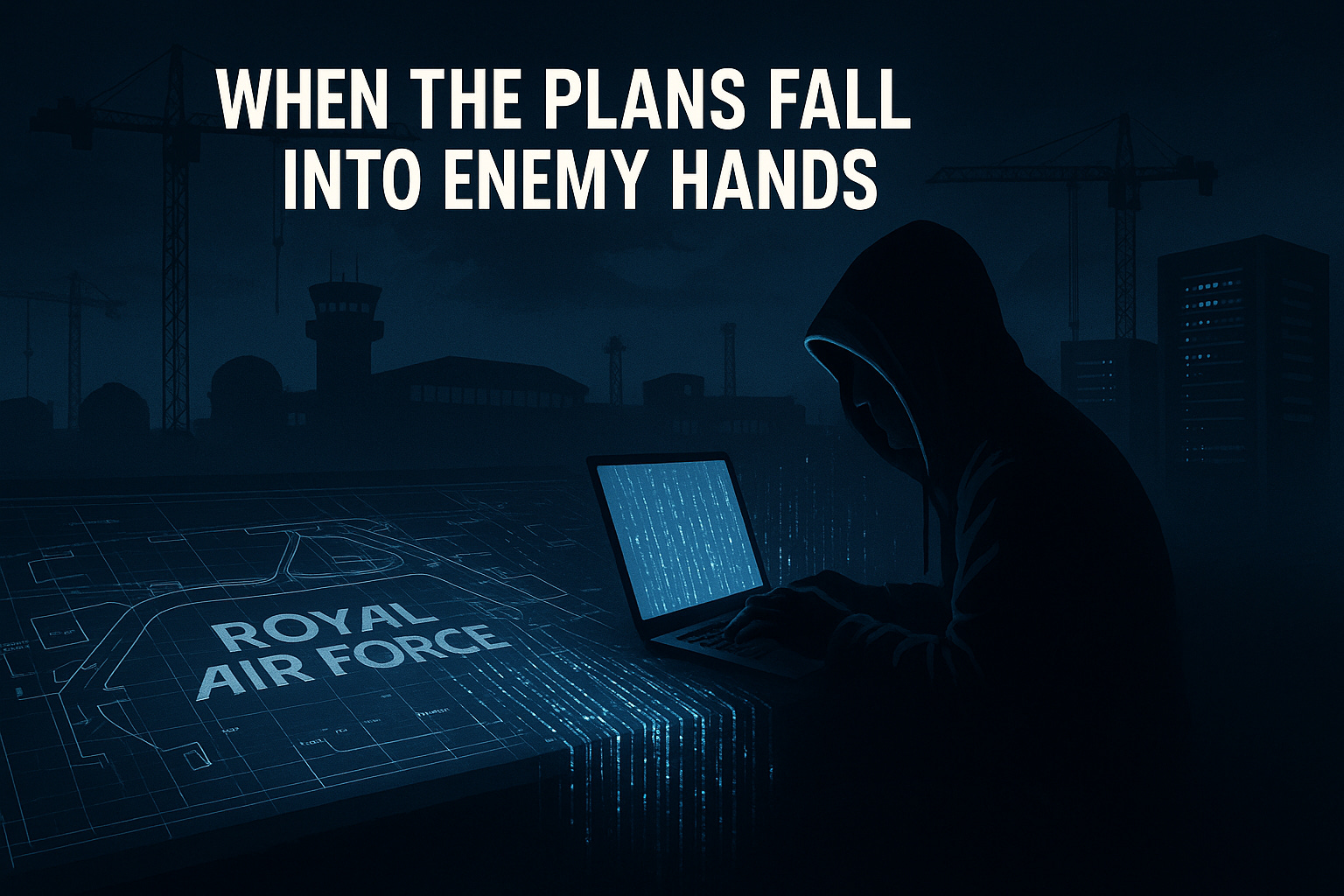
Blueprints of Betrayal: How a Russian Hack Exposed Britain’s Hidden Weak Links
A cyber breach at a UK defence contractor didn’t just endanger military bases — it revealed how vulnerable our entire construction and facilities sector has become.
Why it matters
When blueprints for military installations end up on the dark web, the threat doesn’t stop at the perimeter fence.
It exposes a deeper truth: the same systems that run our hospitals, schools, and infrastructure are often guarded by the same contractors — and the same vulnerabilities.
The breach that shook Britain’s digital foundations
In late 2024, a Russian-linked ransomware group called Lynx broke into Dodd Group, a Shropshire-based maintenance and construction contractor working for the UK Ministry of Defence.
They didn’t just steal files — they stole customer trust.
Within weeks, sensitive documents from eight military bases — including RAF Lakenheath, where US F-35 jets are stationed — began appearing on the dark web. Drawings, access procedures, and contact lists were dumped like trophies.
The MoD confirmed it was investigating what intelligence officials privately called “a catastrophic security lapse.”
Early reports suggest several terabytes of data may have been taken. Even if the total proves smaller, the damage is already done: the adversary now knows how Britain builds its defences.
Who are Lynx — and why they matter
Lynx emerged in 2024 as a rebrand of the INC ransomware operation, part of a growing Russian cyber-crime ecosystem that thrives on Ransomware-as-a-Service.
Affiliates rent the malware, launch attacks, and share profits — a business model that industrialises hacking.
Their hallmarks are depressingly familiar:
Phishing & Impersonation — emails mimicking trusted suppliers to lure staff into clicking.
Exploiting unpatched software — targeting remote-desktop tools and web apps left behind in patch cycles.
Credential harvesting — using tools like Mimikatz to steal passwords and move laterally through networks.
Double extortion — encrypting systems, then leaking stolen data to pressure victims.
Forensic evasion — wiping logs and disabling backups to delay recovery.
None of these techniques are exotic. That’s what makes them terrifying. They work because defences are inconsistent, especially across sprawling contractor networks where dozens of systems connect to client environments.
Blueprints, base maps, and the perfect target
The leaked archive contained an alarming mix: restricted-area drawings, maintenance manuals, visitor lists, and even vehicle registrations tied to staff at RAF and Royal Navy sites such as Lakenheath, Mildenhall, Portreath, Predannack, HMS Drake, and RNAS Culdrose.
This isn’t trivia; it’s operational intelligence.
For an adversary, a site plan is a blueprint for intrusion — whether physical or digital.
The bigger revelation is who held the data. These weren’t MoD servers. They were the contractor’s. The same shared drives and project folders used every day by the construction and FM industry.
We’ve spent a decade or more connecting buildings, digitising operations, and pushing everything into the cloud. Now we’re discovering the cost: the attack surface has moved downstream.
A pattern hiding in plain sight
This isn’t the first contractor breach.
May 2024 — an MoD payroll supplier leaked personal details of 270 000 service personnel.
August 2024 — an MoD subcontractor exposed data on Afghans resettled in the UK.
Autumn 2025 — Dodd Group joins the list, but with strategic assets in the mix.
Each incident follows the same story arc: a small supplier, a routine network, an outdated system — and a hole big enough for a nation-state.
Defence, by design — or by default
The Ministry of Defence sets minimum cybersecurity standards for its suppliers: Cyber Essentials Plus for all, Defence Cyber Certification (DCC) Levels 2–3 for sensitive work, all codfied in their revised defence standard for suppliers, DEFSTAN 05-138 v4. Yet certification alone isn’t enough. Paper compliance can’t patch an unmonitored endpoint.
To protect national security, the UK needs continuous assurance — real-time visibility of who connects, where data lives, and how it’s used. That means moving from “trust by contract” to Zero Trust by architecture.
Seven things construction and FM leaders should do now
Protect your crown jewels.
Separate and tightly control access to BIM models, drawings, and CAFM/BMS exports. They’re not admin files; they’re defence assets.
Close the phishing gap.
Deploy DMARC and domain-spoofing protection. Train staff on realistic supplier-invoice phishing lures.
Patch internet-facing systems fast.
Prioritise RDP, VPN, and web applications. Automate vulnerability scanning and 14-day patch windows.
Make backups immutable.
Keep one offline copy, test restorations quarterly, and block remote access to backup consoles.
Demand proof from your suppliers.
Insist on Cyber Essentials Plus or DCC Level 2/3 certification for high-risk projects, plus evidence of MFA, EDR, and off-site backups.
Run “what-if” drills.
Use stolen drawing scenarios in tabletop exercises. Combine IT, facilities, and physical security teams.
Share intelligence, not blame.
Coordinate with clients and the NCSC’s threat-sharing hubs. Silence benefits the attacker, not the industry.
The bigger picture: from blueprints to deterrence
The files leaked from Dodd Group may expose not only base infrastructure but security assumptions underpinning the UK’s nuclear-capable alliance.
Even if US weapons have not formally returned to RAF Lakenheath, the optics are potent: Russian intelligence can now study the outer layers of Western military protection — designed and maintained by civilian firms.
It’s a strategic own goal delivered through negligence, not espionage brilliance.
Cybersecurity is no longer a technical afterthought in defence procurement; it is defence. The strength of NATO’s deterrent increasingly depends on the cyber hygiene of the electricians, engineers, and FM managers who keep the lights on.
The lesson no one wanted to learn
The Dodd Group incident is a warning written in source code and concrete dust.
When every building is digital and every contractor is connected, the enemy no longer needs to hack the MoD. They just need to hack us.
We drew the plans. They stole the plans. Now we must redraw our defence
The Control Layer brings you sharp analysis on AI, cybersecurity, and the politics of digital power — every story built on evidence, not hype.
Join readers who refuse to be caught off-guard by the next wave of disruption.
Subscribe free — or go deeper as a paid supporter to sustain independent, expert reporting.


