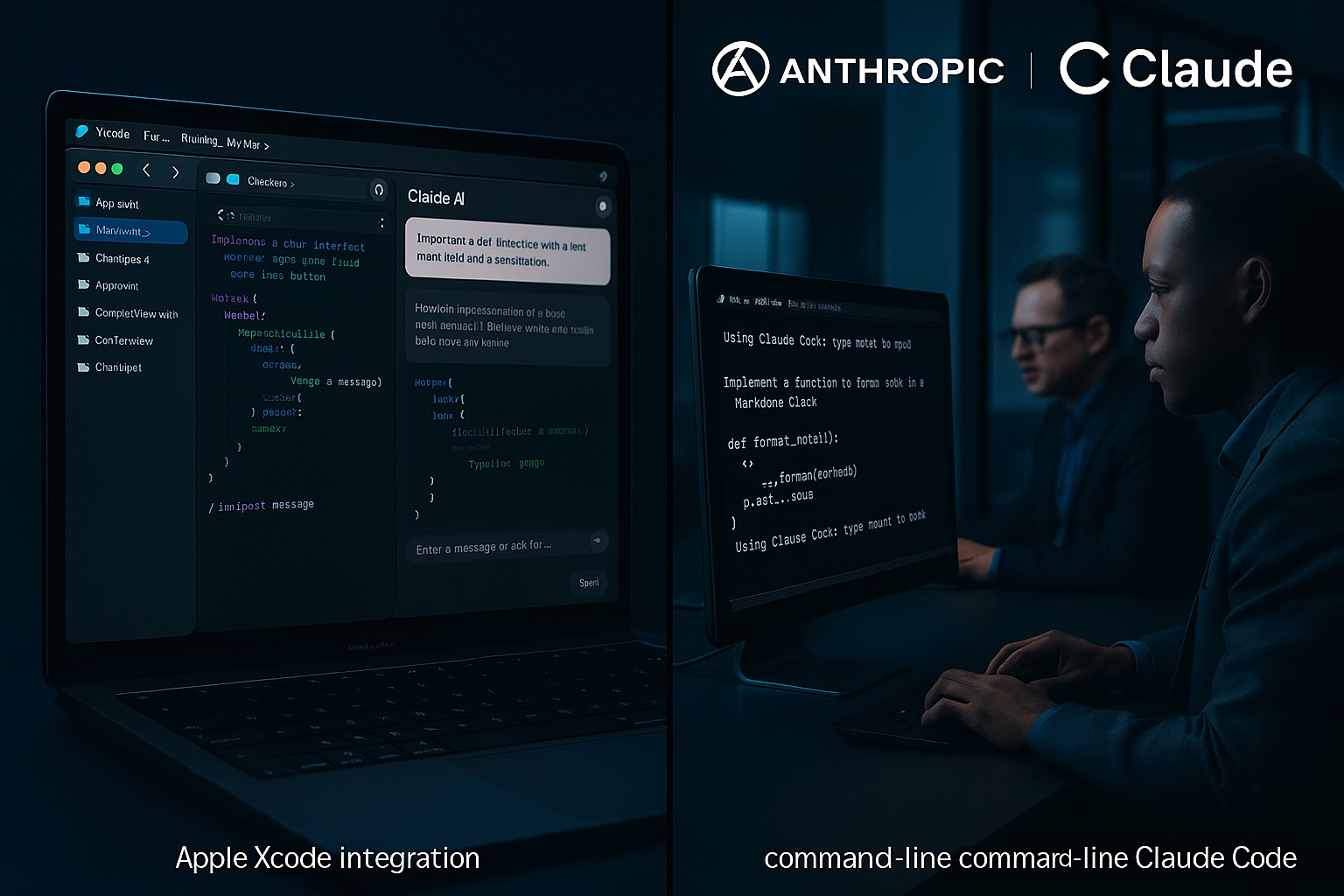
Apple Opens the Door to Claude AI as Anthropic Targets the Enterprise
Two Breakthrough Announcements in the AI Wars
The AI landscape shifted significantly this week, with two announcements that highlight both the enterprise race for developer productivity and the growing willingness of Apple to embrace external AI partners.
Anthropic confirmed that Claude Code, its command-line coding assistant, will now be bundled natively into Claude for Enterprise, eliminating the need for separate subscriptions.
Apple, meanwhile, is preparing to integrate Claude directly into Xcode 26, its flagship development environment, according to evidence discovered in the beta 7 release.
Taken together, these moves illustrate the intensifying competition in enterprise AI development tools — and the remarkable fact that Apple, long wedded to its closed ecosystem, is opening the door to third-party AI providers beyond OpenAI.
Anthropic Bundles Claude Code into Enterprise
Anthropic’s announcement addresses a long-standing pain point for enterprise customers. Until now, developers using Claude Code often ran into unexpected usage limits, particularly during peak projects. By rolling the tool into Claude for Enterprise, businesses will be able to:
Set granular spending controls, allocating usage budgets across teams.
Scale effectively during intensive development periods without service interruptions.
Track consumption more transparently through a newly launched Compliance API, which provides programmatic access to usage data for governance, auditing, and regulatory compliance.
Early Results: 2–10x Faster Development
Early enterprise customers, including Behavox and Altana, report that teams deploying Claude across hundreds of developers are seeing 2–10x increases in development velocity. That claim may be difficult to measure precisely, but it underlines how tightly integrated coding assistants are becoming in the enterprise software lifecycle.
By eliminating the friction of multiple subscriptions, Anthropic is positioning itself as a credible competitor to GitHub Copilot Enterprise and Google’s Gemini Code Assist, both of which already offered built-in enterprise features.
Apple’s Pivot: Claude AI in Xcode 26
On the consumer and developer front, Apple is preparing a move that could be even more disruptive. Evidence found in the beta 7 release of Xcode 26 points to native integration of Claude Sonnet 4.0 and Claude Opus 4, marking the company’s first support for a third-party AI provider beyond OpenAI.
Reviving Swift Assist
The integration is seen as the revival of Swift Assist, a coding tool first announced at WWDC 2024 but quietly shelved due to performance problems. Now, Apple appears to be rebooting the feature — and expanding it to support multiple models, not just its in-house AI.
With Xcode 26, developers will be able to choose between:
Apple’s own AI models
Native ChatGPT integration (with daily caps)
Anthropic’s Claude
Local models running directly on developer machines
This marks a sharp shift for Apple, which has traditionally guarded its ecosystem with closed walls.
Beyond Xcode: Siri and Writing Tools?
Intriguingly, server-side configuration files suggest that Claude’s integration may not stop at Xcode. Apple appears to be testing options for Claude to power Siri or serve as an alternative within system-wide Writing Tools. While Apple has not confirmed this, the very possibility points to a broader strategy: enabling choice between AI providers across its platforms.
Why These Moves Matter
Both announcements point to a deeper trend: AI is becoming a core layer of enterprise and developer productivity, and the winners will be those who offer flexibility, compliance, and scale.
For Anthropic, bundling Claude Code into Enterprise simplifies the buying decision for CIOs and CTOs. With usage controls and compliance APIs, it directly addresses procurement and governance headaches that have slowed adoption in regulated industries.
For Apple, integrating Claude represents a cultural shift as much as a technical one. By offering developers choice between models, Apple acknowledges that no single AI will dominate every workflow — and that openness may be more valuable than control.
The Competitive Landscape
Microsoft, with GitHub Copilot and Azure, has led the charge on enterprise AI coding. Google, with Gemini, has integrated its assistant directly into developer tools and cloud platforms. Now Anthropic is signalling that it can match them feature for feature.
Apple, meanwhile, is late to the AI party but is leveraging its developer ecosystem as a wedge. If Xcode 26 ships with Claude and ChatGPT integration side by side, it could normalise multi-model AI development in a way no other platform has.
The Bigger Picture
We are witnessing the next phase of the AI arms race. The first wave was about training the biggest model. The second is about distribution — getting those models embedded into everyday tools where developers and enterprises live.
Anthropic’s enterprise bundling and Apple’s Xcode integration both serve this end: lowering barriers to adoption, simplifying governance, and accelerating productivity.
For UK businesses, the implications are immediate:
Enterprises adopting AI coding assistants need to consider compliance features as much as raw model quality.
Developers in Apple’s ecosystem will soon be able to experiment with multiple models inside Xcode — raising questions of pricing, model selection, and best practices for safe use.
Regulators will likely view Anthropic’s Compliance API as a step toward the accountability frameworks being demanded in both the UK and EU.
Conclusion: A New Phase of AI Integration
The bundling of Claude Code into Anthropic’s enterprise suite and Apple’s preparation to ship Claude in Xcode 26 may seem like separate stories. Yet both reflect the same reality: AI is no longer an optional add-on — it is becoming part of the infrastructure of software development.
For enterprises, the key questions will be about governance and cost management. For developers, it will be about model choice and workflow integration. And for Apple, this is perhaps the most radical step of all — signalling a willingness to open its ecosystem in ways few expected.
The AI race is entering its platform phase. The companies that win will not just have the best models, but the most seamless integrations, the strongest compliance tools, and the widest developer adoption. Anthropic and Apple have just signalled that they intend to be among them.


